


© Copyright – 2026 – Athletics Illustrated
Meet Jim Shorts, Athletics Illustrated Magazine’s first official ambassador.
While he is one, do not refer to Jim Shorts as a run ambassador, at least not to his face.
If anything, Jim is a run instigator—a blunt force trauma reminder that running existed long before GPS watches, influencers and perfectly edited sunrise selfies.
His job is simple: Lead by example.
He does this with old-school advice, hard-earned knowledge, the occasional witty quip, and a chiselled perspective formed through decades of head-down miles and a stubborn refusal to miss a day.
The athlete
Jim is a former boxer, rugby union winger, and box lacrosse corner. He was a near-elite runner who competed at the national level. A competitor shaped by thousands of hours spent embracing the Trial of the Miles.
Weather conditions do not matter.
His philosophy is simple: Err on the side of choosing to run.
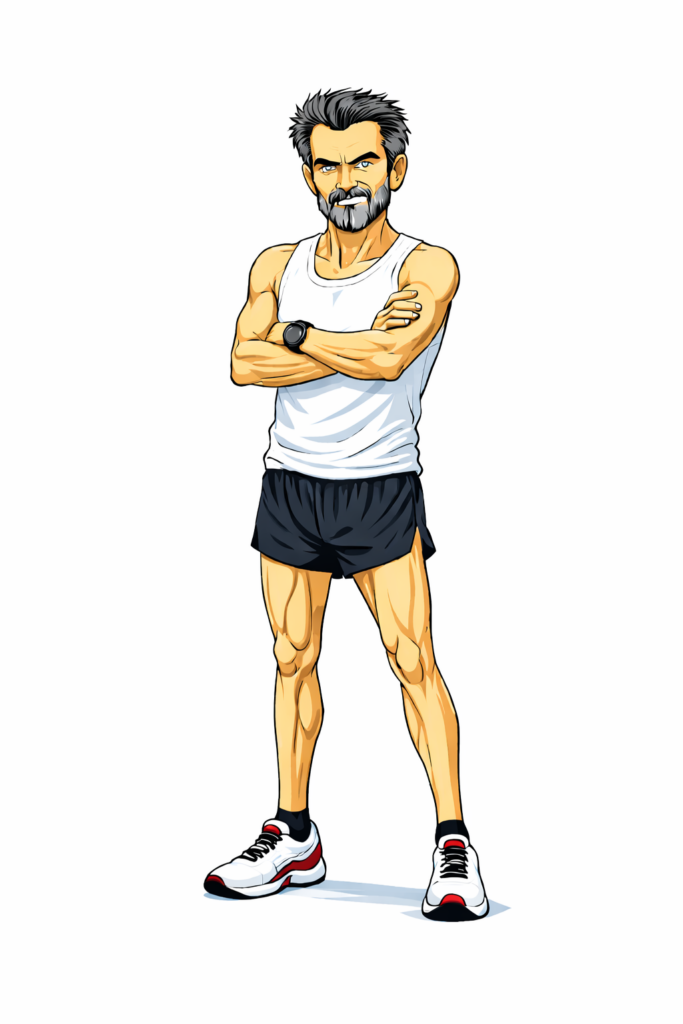
Jim often runs in the woods. He trains on the roads too and visits the track when preparing for an upcoming race, but only then. On many mornings, he is the first to emerge, breaking spider webs with his face before the sun has climbed over the trees.
He wears a watch, but rarely uses it. Mostly, it reminds him what day it is—or how many hours have passed during the run.
Jim runs by feel.
Not by pace charts.
Not by heart rate zones.
Not by what a so-called “smart watch” tells him.
He doesn’t wear armbands, water belts, headphones, reflective harnesses, or hydration packs. He carries nothing but the effort he feels in his legs and the knowledge of his own limits, unless he runs 50K or more. The modern runner might refer to this as “running naked.” Jim feels running should not be cluttered by distractions and useless frills and trinkets.
Jim couldn’t care less what anyone thinks on Strava. He is there because a friend created his account when he wasn’t looking.
He measures running by time spent, not necessarily distance travelled. Three hours in the woods is three hours in the woods.
Scheduled rest days are a foreign concept. Sometimes he arrives home having forgotten whether he is starting his workday or heading to bed.
Jim solves most of his own injuries and brews his own beer. Duct tape is indispensable.
He believes modern runners are too busy filming themselves instead of running. By the time an influencer’s video is shot, edited, posted and promoted, Jim has already finished his run and is preparing for another.
He owns approximately a dozen identical pairs of split shorts and wears whatever shirt happens to be hanging on the clothesline that morning. Probably, a faded souvenir from a 10K in Yakima, Portland or Vancouver. Some are not race shirts. One of his favourites has an image of Bill Murray, another Champion Spark Plugs, and a very smooth cotton-poly blended tee with the image of El Chapo being arrested.
“When I run, I am living…
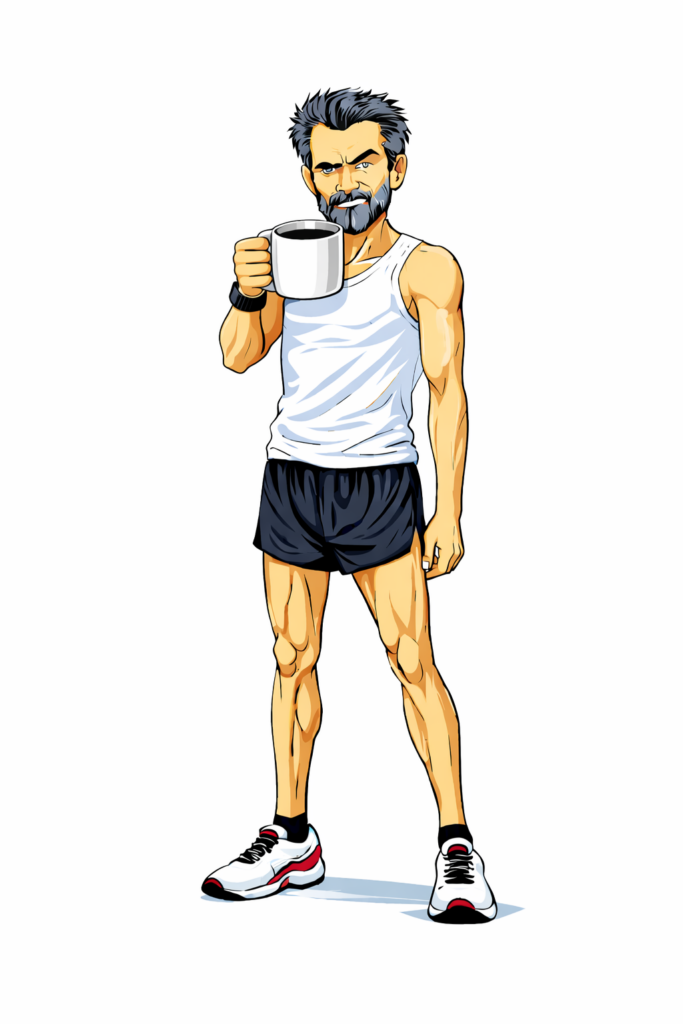
“I am closer to the things that are real. During a long run, I can relive sections of Once a Runner or solve world problems. On my weekly three-hour run through the deep salal and ferns of the temperate rain forest, the bears, curious, stand on their hind legs as I pass like a ghost floating across a bed of pine needles, hiding the muddy trail surface beneath it.”
The character
Jim is somewhere in the thick of his 40s, and continues to run 10K races at just over 30 minutes, marathons around 2:28, and keeps himself at or near the front of most short ultras.
He once ran across the City of Vancouver to beat a friend to work who was riding a bus. He gave him a wink at the first three stops before burying the noisy diesel dinosaur.
In Maui, while friends attended a luau, Jim ran up Mt. Haleakalā—climbing from sea level to 10,023 feet (3055m) and only stopping to let a family of mongooses scurry past. He reached the summit in 4:16:47, unofficially one second slower than the sea-to-sky record set by Kanoa King. He ran back down with reckless abandon, scattering tourists and a few hoary bats along the way.
The philosophy
Jim Shorts has one overarching guide about running: Run first. Everything else can wait.
Top-10 rules to live by
Jim Shorts does not believe in complicated training plans.
Over the years, he has developed a set of rules that have served him well. They are simple, stubborn, and metaphorically written in blood and pine needles.
1. Run first
Before excuses set in. When you run first, the day is won.
2. Err on the side of choosing to run
If you are debating whether you should run today, the answer is yes.
3. Run by feel
Watches are fine, but your legs know everything; respect them.
4. Time matters more than distance
Three hours in the woods is three hours in the woods. Whether that ends up being 20 miles or 16 miles doesn’t matter.
5. The woods solve most problems
Long runs in quiet places clear the mind better than a social media post.
6. Simplify
Running requires shoes and the willingness to embrace the toil. Everything else is fluffery.
7. Run alone some of the time
Running with others is good. Running alone is a delicious smile on a dog’s face.
When no one is there to impress, you find out how honest your effort really is.
8. Consistency trumps everything
The best training plan is the one that keeps you moving.
9. Long runs are sacred
Once a week, go long, unless racing.
How long? As long as necessary.
10. Gaunt is beautiful
And so is a frock of unkempt hair, the almighty untucked shirt and mud-streaked calves.
Jim cites his mentors:
Rod Dixon, Percy Cerutty, Lorraine Moller, Toshiko Seko, Haile Gebrselassie, Dr. George Sheehan, Lynn Kanuka, Arthur Taylor, Rob de Castella, Emil Zapotek, Lasse Viren, Arthur Lydiard, Ann Trason, Joe Vigil and Al Howie, to name a few.
Welcome, Jim Shorts.