
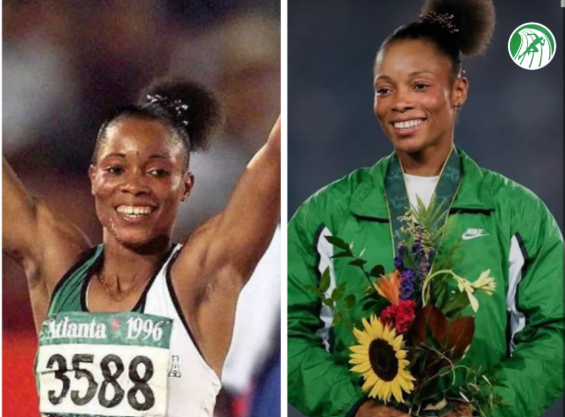
The Athletics Integrity Unit (AIU) has lifted the lifetime ban on Nigerian long jumper Chioma Ajunwa, ending a period of ineligibility that began in 2002. The 54-year-old, Nigeria’s first individual Olympic gold medallist, is immediately eligible to take part in athletics in any capacity.
Background
Ajunwa tested positive for the anabolic steroid nandrolone at the Tsiklitiria Grand Prix in Athens on June 10, 2002. Because it was her second violation, following a 1992 positive test for methandienone that carried a four-year suspension, the Athletics Federation of Nigeria (AFN) imposed a lifetime ban, as the rules then required. World Athletics, then the International Association of Athletics Federations, recorded the sanction in 2003.
Basis for the decision
Transitional provisions in the World Athletics Anti-Doping Rules, in force since January 2026, allow athletes still serving sanctions imposed under earlier rules to seek a review where current rules prescribe a lesser penalty. Ajunwa applied on August 28, and the AIU assessed her case under the principle of lex mitior, which permits a more lenient sanctioning rule to be applied retrospectively.
In its decision of November 18, issued in Monaco, the AIU found that the current rules prescribe a four-year suspension for a first violation involving nandrolone. For a second violation, the rules provide two calculation methods: adding the first-violation penalty to the penalty that would apply to the second violation without a prior record, or doubling the latter. Both methods give Ajunwa an eight-year suspension.
Having served nearly 24 years, Ajunwa has far exceeded that period, and the AIU ended her ineligibility with immediate effect. The decision does not erase her violations. It restores her eligibility to participate in official athletics activities as an athlete, coach, administrator or official. Ajunwa, the AFN, the Nigerian National Anti-Doping Committee and the World Anti-Doping Agency have all been notified.
Ajunwa’s response
The AIU decision records that no appeal was lodged against the original sanction. Ajunwa has said that officials leading the federation at the time failed to pursue her attempts to challenge the ban. She told a Nigerian newspaper that fellow athlete Rosa Collins travelled to Monaco to press for a new hearing but was directed back to the AFN.
“She came back and went to the AFN officials, but they were not ready to listen to her. That is how I was meted an undeserved punishment, which brought my career to an abrupt end,” Ajunwa said.
She said she holds no resentment, but urged Nigerian athletics leaders to better understand technical and anti-doping regulations so similar cases do not recur.
Speaking to THISDAY, she welcomed the decision: “I give thanks to God that the stain has been removed from my athletics career. I am now free to participate in all activities.”
About Chioma Ajunwa
At the 1996 Atlanta Olympics, Ajunwa’s 7.12-metre leap made her Nigeria’s first individual Olympic gold medallist and the first African woman to win Olympic gold in a field event. Five years earlier, she had represented Nigeria at the inaugural FIFA Women’s World Cup in China. A retired deputy commissioner of police, she now mentors young athletes through her foundation.