© Copyright – 2025 – Athletics Illustrated
What is that aphorism about the many governing the few and the few governing the many leading to chaos (or bad marketing decisions)?
World Athletics proposed and trialled a change in the long jump event. The purpose was to reduce the chance of athletes fouling out of the sport. The intent was to make the long jump more exciting for fans. So goes good intentions.
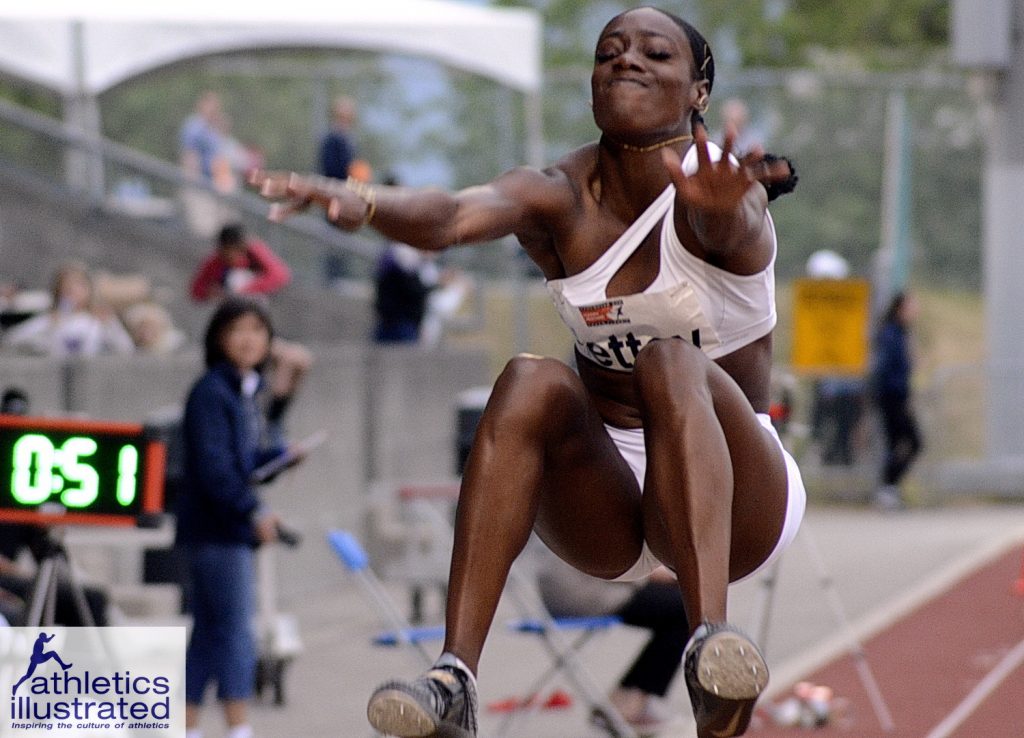
The idea was to make the take-off board bigger. Then, to measure from where the athlete took off, rather than if they hit the board properly.
The traditional approach
The traditional system uses a single, fixed board (typically white) that is 1.22 metres (4 feet) long and 20 cms (8 inches) wide. Part of the challenge and technical skill brought to the event is to calculate and execute the sprint toward the board before jumping.
The fans favoured the new method, but the athletes ultimately did not. Therefore, the experiment is over and long jump will maintain its traditional approach.
The jump distance is measured from the edge of this board closest to the landing pit. Athletes must take off before crossing this edge. A plasticine indicator board is often used to detect whether an athlete’s foot goes over the line. If so, this results in an invalid attempt (a foul or “no-jump”).
This system results in a high number of invalid jumps, sometimes as many as 30 per cent of attempts. This is not great for marketing. Some argue that it interrupts the flow of the event for spectators.
Proposed new long jump platform
The proposed system would have replaced the single board with a wider take-off zone. The primary difference was the removal of the foul line. Every jump would have been counted and measured.
Instead of measuring from a fixed line, the jump distance would be measured using camera technology. This was be taken from the exact point where the athlete’s front foot left the ground within the zone.
Meanwhile, the goal here was to reduce the number of non-action periods during competition. Thereby, making the event more exciting for fans.
At the end of the day, World Athletics decided to put the take-off zone proposal on hold indefinitely. This was due to widespread criticism and a lack of support from athletes. The athletes felt it fundamentally altered the technical challenge and “authenticity” of the event.
History
Historically, the long jump dates back to ancient Greek pentathlons (708 B.C.). Interestingly, athletes used weights (halteres) for momentum, to their inclusion in the first modern Olympics (1896) as the “broad jump.” The event evolved with techniques like the hitch-kick, leading to legendary performances by Jesse Owens (1936) and Bob Beamon (1968).
The long jump welcomed women in the Olympics in the 1948 London Olympic Games.
The broad jump and long jump start with the sprint. Athletes leap off the bater (the board) and into the “skamma,” which is now known as the sand pit.
The men’s world record was set by American Mike Powell, who leaped 8.95m (29 ft 4.25 in) in 1991. The women’s world record was set by Soviet (Russian) athlete Galina Chistyakova in 1988. She flew 7.52m (24 ft 8 in).