

By Paul Gains
Ugandan long‑distance runners have emerged from the shadows cast by their legendary East African neighbours to earn distinction at the highest level. Now, Stephen Kissa will represent his nation at the 2026 TCS Toronto Waterfront Marathon on October 18, facing a strong contingent of Kenyan and Ethiopian athletes. The event is once again a World Athletics Elite Label race.
Kissa set a Ugandan national record of 2:04:48 when he made his marathon debut in Hamburg, finishing second. That record, set in 2022, was only surpassed this year. His performance earned him selection to Uganda’s team for the 2023 World Championships marathon, where he finished 5th on the streets of Budapest.
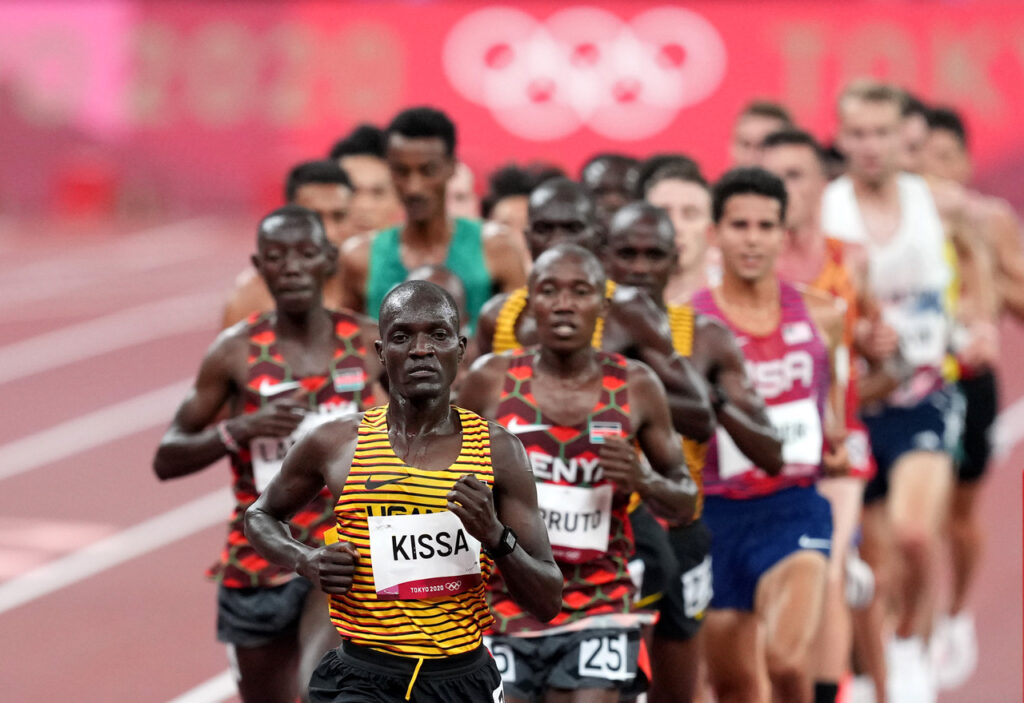
He has twice represented Uganda at the Olympics and at the World Cross Country Championships. With such experience, the 37‑year‑old is understandably intent on challenging for the $25,000 CDN first‑place prize in Toronto.
“When I come to Toronto, I will do my best. I will do my best,” he says with a broad smile. “I am really happy if I can run 2:03 or 2:04.
“With training, we have been comparing the past to now, and we have come up with a solution. Long runs, tempo runs—we do them ranging from 25km, 28km, 30km up to 40km. I am running around 120km a week but will go up closer to 200km.”
Kissa is not the first Ugandan to compete at the Toronto Waterfront Marathon. Stephen Kiprotich, the 2012 Olympic champion, finished 7th in the 2018 edition. Kiprotich remains a national hero, and his success has greatly contributed to Uganda’s emergence as a distance‑running power.
“About the marathon, I was really inspired a long time back by Stephen Kiprotich,” Kissa admits. “He did tremendous work, and I can say he is our mentor. We really respect him.
“He has given me advice. ‘Our sport is not a one‑day journey,’ he said. ‘It is a long journey that takes a lot of patience and commitment. If you have commitment, patience, and hard work, it will go far.’”
Kiprotich has been an occasional—and very welcome—visitor to the training camp in Kapchorwa, which Kissa calls home for most of the year. The camp sits at 2,500m (8,200 feet) above sea level.
From Monday to Saturday, Kissa trains with a group that includes Joshua Cheptegei (two‑time Olympic champion at 5000m and 10,000m), Victor Kiplangat (2023 World Marathon Champion), and Peruth Chemutai (2022 Olympic 3,000m steeplechase champion).
The centre was built by their management company, Global Sports Communications, with a contribution from Cheptegei. The athletes return home to their families on Saturday evenings. Kissa lives in Kapchorwa’s town centre, about 14 kilometres away, below the slopes of Mount Elgon, an extinct volcano estimated to be 24 million years old. He has a wife and two young children.
“Right now they are at school,” he says. “They are about to come home for a holiday. That’s when I will meet them. When there is no problem, they wait until the holidays. At school, they concentrate on their studies unless there is a problem—then they will call me.”
The training camp includes a dormitory, dining room, kitchen, and a recreation room where the group gathers to watch sports. The recent FIFA World Cup drew great interest, and Kissa enjoyed watching Spanish winger Lamine Yamal. Asked how he relaxes, he smiles.
“I can play pool—I like that,” he says with a laugh. “Not for money. There are also cards; we play cards.
“Sometimes, when I have time, I can cook chapati. It is made from wheat flour. And we have potatoes also, and ugali (made from corn).”
A group prayer is held before each workout. Kiplangat is an assistant pastor at a nearby church called Temple of the Most High God, but the others, including Kissa, also take turns leading prayers.
For more than a decade, the group has been coached by Addy Ruiter, although after the 2024 Paris Olympics, the Dutchman returned home. He still coaches remotely via WhatsApp, with a team on the ground led by compatriot Roy Hoornweg.
“The nature of Kapchorwa itself—it is hilly, it is a mountainous area,” Kissa explains. “I was telling you about the tempo runs. Those are done on a plateau. There it is flat. Our training is different depending on the location. You can’t do long runs in the hilly area, so we tend to go to the plateau. We also have flatlands where we can do long runs and tempo runs.”
Kissa knows he is nearing the end of his running career and must look to a future beyond competition. Still, he laughs when asked how many more years he can compete: “Maybe ten years! I will be happy if I can run 2:03 or 2:04!”
“If Toronto goes really well, of course I will look to invest in assets in town—build apartments and some business. I can really say thank you for inviting me to Toronto. If it goes well, I will be very proud of it.”
Kissa won’t be the only Ugandan in Toronto. At the Runner’s Expo on October 16 and 17 at the Better Living Centre, there will be a Uganda Tourism booth featuring information on the Mount Ruwenzori Marathon and Great Lakes Safaris.
On the starting line, he can be confident in his vast international experience and his ability to compete with anyone. As for his ultimate goals, he is succinct.
“I pray that in some years to come I should be on a podium at maybe the Olympics or World Championships,” he says. “That is what I am really looking forward to.”
A victory in Toronto would bolster that ambition.