
The 33rd edition of the IAU World Championships and the 100 km event brought together to athletes from 43 countries, to Ames, Spain with 147 men and 102 women starting the race.
The biennial championships were last contested on Dec. 7, 2024, in Bengaluru, India. This time, the athletes faced a 20-lap, 5-km course, along with a considerable change in temperature over the roughly seven-hour race. Conditions rose from about 16 C (61 F) in the morning to 31 C (90 F) by the finish.
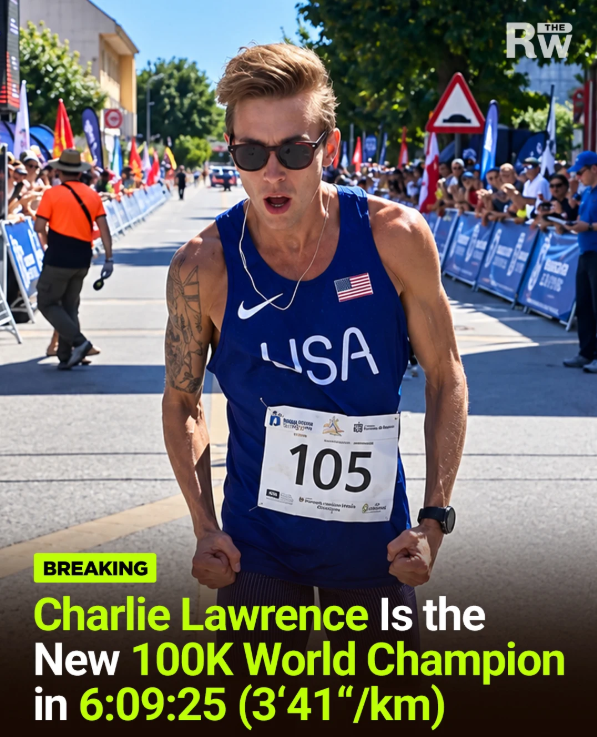
On Sunday, Sept. 20, it was Americans Charlie Lawrence and Courtney Olsen who emerged as the men’s and women’s champions.
Men
Masato Tanaka of Japan came out aggressively, opening a 10-second advantage on Charlie Lawrence, with world-record-holder Aleksandr Sorokin of Lithuania settling into third.
By the end of the first lap, Tanaka’s lead had grown to 40 seconds. He continued to press through the early stages while Lawrence gradually closed the gap.
On the third lap, Lawrence was nearly on Tanaka and had opened five seconds on Sorokin. Lawrence’s split was three seconds faster than Tanaka’s, although the pace would eventually exact a price.
Tanaka rebuilt his advantage through the middle portion of the race and carried a two-minute lead over Lawrence entering the seventh lap.
Lawrence responded with his fastest lap of the race to that point, running 17:40. He followed with 17:45 on lap eight, but still trailed Tanaka by more than a minute.
The chase was beginning to thin out. Runners were increasingly moving around the circuit alone rather than in groups, the gaps becoming more significant with every lap.
Lawrence ran 17:59 on lap nine, still faster than Tanaka, and finally moved into the lead at halfway. He crossed the midpoint in just over three hours after another sub-18-minute lap.
For a while, the American record and perhaps something considerably larger appeared to be in play.
Then came the heat.
Lawrence ran 18:05 on lap 11 and 18:22 on lap 12. The increasingly warm conditions, combined with the work required to chase down Tanaka, were beginning to show.
Austin Gray moved around Sorokin and into second on lap 14. Gray had not broken 18:24 for a 5-km split during the first half of the race, but then strung together laps of 18:15, 18:09 and 18:22 on laps 12, 13 and 14.
Sorokin, meanwhile, recorded 18:39, 18:41 and 18:38 over the same three laps.
Gray, the surprise U.S. marathon champion in 2018 with a 2:12:38, has increasingly moved toward longer distances. He ran 5:02 at the 2025 Tunnel Hill 50 Mile and 6:34 at the Mad City 100K in April 2026.
Lawrence slowed to 19:02 on lap 15.
The world-record attempt was effectively gone, and his advantage over Gray and Sorokin was beginning to disappear as well.
Great Britain’s Milne was moving strongly and reached fourth on lap 16. France suddenly had three runners inside the top 10, with Justin Dourlens, Jason Pointeau and Steven Galibert all moving through the latter half of the race together.
But Lawrence had built enough of a cushion early.
He held on to take the world title in 6:09:25, roughly two minutes outside his American record for 100 km. Sorokin finished second.
Women
Courtney Olsen’s race developed differently.
Miho Nakata of Japan and Satu Lipiäinen of Finland established themselves at the front from the opening kilometres. Their first 5-km lap was 20:05.
Nakata edged six seconds ahead of Lipiäinen on lap two, with Spain’s Gemma Arenas another 29 seconds back in third. Finland’s Noora Honkala occupied fourth.
Nakata and Lipiäinen remained first and second through five laps, with the early pace establishing a significant separation from much of the field.
Olsen, meanwhile, was running sixth.
The race began to change during the second half.
Lipiäinen surrendered second place on lap 10 as Nakata also began to slow. The Japanese leader’s 5-km splits gradually drifted from 20:06 toward 21:34.
Olsen went the other direction.
She ran 20:56 for her 10th lap and continued to close the gap. The race was becoming less about maintaining position and more about who could continue running efficiently as the temperature climbed.
Great Britain’s Sarah Webster, the 24-hour world-record holder, was also moving through the field. She was fifth late in the race and appeared to be closing on the leaders.
Olsen finally caught Nakata during the 17th lap.
From there, the American did what she had been doing for much of the second half: kept moving.
Olsen crossed the line in 7:10:31 to win the world title. Nakata finished second in 7:11:57, 1:26 behind.
Spain’s Gemma Arenas was third in 7:17:50, followed by Finland’s Noora Honkala in 7:21:37.
Croatia had three athletes in the top 10, led by Nikolina Šustić-Stanković in fifth, Nataša Šustić in seventh and Mirjana Šimek Bilic in 10th. Spain also placed two athletes in the top 10, while France had Malory Leroy and Selina Leroy finish eighth and ninth.
Men’s top 10
| Place | Athlete | Country | Time |
|---|---|---|---|
| 1 | Charlie Lawrence | U.S. | 6:09:25 |
| 2 | Aleksandr Sorokin | Lithuania | 6:12:41 |
| 3 | Alex Milne | U.K. | 6:17:50 |
| 4 | Dariusz Nożyński | Poland | 6:23:47 |
| 5 | Jason Pointeau | France | 6:24:34 |
| 6 | Steven Galibert | France | 6:25:30 |
| 7 | Hugh Tibbs | U.K. | 6:26:54 |
| 8 | Brogan Austin | U.S. | 6:27:50 |
| 9 | Olle Meijer | Sweden | 6:29:55 |
| 10 | Carlos Gazapo | Spain | 6:31:09 |
Women’s top 10
| Place | Athlete | Country | Time |
|---|---|---|---|
| 1 | Courtney Olsen | U.S. | 7:10:31 |
| 2 | Miho Nakata | Japan | 7:11:57 |
| 3 | Gemma Arenas | Spain | 7:17:50 |
| 4 | Noora Honkala | Finland | 7:21:37 |
| 5 | Nikolina Šustić-Stanković | Croatia | 7:21:57 |
| 6 | Estefanía Unzu | Spain | 7:22:13 |
| 7 | Nataša Šustić | Croatia | 7:22:43 |
| 8 | Malory Leroy | France | 7:24:07 |
| 9 | Selina Leroy | France | 7:26:29 |
| 10 | Mirjana Šimek Bilic | Croatia | 7:27:46 |