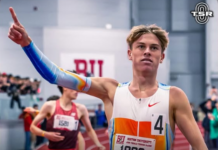
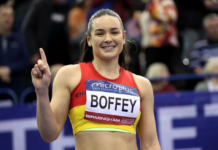
The First Half has earned international recognition as Canada’s fastest half-marathon, welcoming elite and recreational runners alike to a stunning waterfront course. The event made headlines in 2023 when Olympian Cam Levins set a new Canadian national record at this event in a blazing 1:00:18. Fellow Olympian, Natasha Wodak, broke the First Half event record that same year in 1:10:17, establishing Vancouver’s First Half as a destination for fast times and fierce competition.
For both athletes, the First Half is an indicator event on the way to their next marathon. Tokyo for Levins, who took the North American record in 2023 with his 2:05:36 performance and Ottawa for Wodak. She holds the current Canadian record at 2:23:12 from Berlin in 2022.
The men
Levins told Athletics Illustrated, “[I am] just planning on getting another good effort in the half during the lead up to Tokyo, but I’d obviously be thrilled with a personal best, so just have to see how I feel on the day.”
Tokyo is scheduled for March 1.

Levins’ best is still 1:00:18. The current holder of the Canadian half-marathon record is Rory Linkletter, who clocked 59:49 at the January 11, 2026, running of the Houston Half Marathon. He is the first Canadian to go under the 60-minute benchmark.
Levins may have some competition for the first half of the First Half from fellow Canadians Andrew Davies and Justin Kent, who are both running well. Kent set his official personal best in 2022 in San Jose, CA, at 1:02:48. Although he has run faster, during the pandemic on an uncertified course.
Davies ran the 2025 First Half in 1:03:05 for the win.
The women
As for Wodak, she too once held the Canadian half-marathon record when she ran 1:09:41 in 2020. She was the first Canadian to go under the 70-minute benchmark. While Wodak continues to have goals to compete internationally, she recently suffered a fall at a race, and her training was interrupted for a spell.
“I will race as hard as I can, but given my setbacks in the last three weeks, it won’t be close to a PB. But, am hoping to get close to 1:12:00,” she said. “Its a pretty stacked field, so will do my best to compete well.”

Wodak took the half-marathon record in Houston in 2020, but it lasted exactly two weeks. It was bettered by Andrea Seccafien, who ran three seconds faster at the Marugame Half Marathon. Seccafien also took Wodak’s national 10,000m record that year. She has paused her international running career and is attending university in Australia.
Also in the field is Olympian Malindi Elmore of Kelowna. Her personal best in the marathon is just a few seconds slower than Wodak’s at 2:23:30, which she set in Berlin three years ago, the year after Wodak set the current national record. That same year, Elmore clocked a 1:10:11 in Gifu, Japan, which is her current PB.
Vancouver-area runner and Tokyo Olympian Dayna Pidhoresky is also racing. She won the First Half 10 and 11 years prior in 2015 and 2016. Her best is 1:12:38; however, she ran an unofficial 1:11:36 in Niagara Falls, ON, in 2011.
The First Half defending champion, Samantha Jory, is back. She won last year in a new PB time of 1:13:36. Also, on the start line will be Andrea Lee, hoping to improve her 1:17:54 from the First Half 2023.
Olympic racewalker Olivia Lundman from Nanaimo, BC, will be racing. She has racewalked the half-marathon distance in the time of 1:43:21.
The course is fast
The course was already fast; however, there have been some changes. The new 2026 course extends slightly at the start, looping BC Place, plus goes around Second Beach Pool on the ‘out route,’ removing an old crossover by staying left throughout. In theory, this route is faster as it also remains on roadways and the Seawall, removing the gravel loop of Lost Lagoon.
The race is also scenic, if the sun pops out, the North Shore Mountains, Stanley Park and ocean waterways are visible in Burrard Inlet.
“We’re excited to open the RUNVAN race season with the First Half. The depth of the elite field and the continued interest from Canada’s top athletes speak to the speed of this course and the quality of the event,” says RUNVAN race director, Eric Chéné.
Originally organized in 1988 as a build-up event to the Vancouver Marathon, the First Half has evolved into a highly sought-after and celebrated community race.