

The 2026 Boston Marathon was fast due to a tailwind that lasted the entire race.
John Korir and fellow Kenyan Sharon Lokedi won. Korir stormed to victory in 2:01:52, taking more than a minute off the long-standing course record and producing one of the fastest marathons ever run.
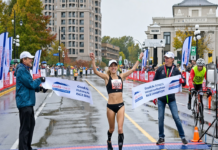
Lokedi matched his feat with a repeat win in 2:18:51, as she started conservatively and gradually picked off her competitors throughout. She capped the race off with a late race effort that put her well clear of the other women. With the competitive fields, and favourable wind records fell.
Some were actively trying to drop competitors with surges, especially after the 20-mile or 32 km mark. The top 13 finishers in the men’s race field broke 2:06, and the top 28 ran faster than 2:10. The top 10 women finished inside 2:23.
Men’s Race
The early pace told you this one wasn’t going to hang around. A sizeable lead group, with Alex Maier setting the tone, rolled through 10K in 29:02, quick enough to thin things out later without immediately blowing the race apart.
It was Lemi Berhanu who first tried to force the issue just after 20K. He nudged things along and hit halfway in 1:01:43, but it never quite felt decisive. That came later.
Milkesa Mengesha took over heading into the Newton Hills, ticking off 25K in 1:13:02 and keeping the pressure steady. For a stretch, it looked like a grinding attritional move, but Boston rarely rewards half-measures. John Korir made sure of that.
Just before 20 miles, Korir delivered the move that mattered. It wasn’t dramatic in the moment, but it was definitive. By the top of Heartbreak Hill, he’d split a 4:36 mile and opened 40 seconds. From there, it was effectively over.
What stood out wasn’t just the move; it was the follow-through. Korir didn’t ease. He kept the effort pinned, extending the gap to 26 seconds by 35K and 43 by 40K. No one behind could organize a response.
He closed with a negative split of 1:01:50 / 1:00:50, and in doing so took 1:10 off Geoffrey Mutai’s long-standing course record. On a course like Boston, that’s not just quick, it’s authoritative.
Behind him, the race reshuffled. Benson Kipruto and Alphonce Simbu emerged as the only real challengers for the podium as Mengesha drifted back. Simbu edged Kipruto late, 2:02:47 to 2:02:50, both comfortably under the previous course record.
Further back, there were a few notable performances. Zouhair Talbi ran 2:03:45, faster than the previous U.S. best on the course, though Boston’s point-to-point profile keeps it out of the record books. Tebello Ramakongoana set a national record (2:04:18), and Charles Hicks led the American contingent in 2:04:35.
Korir, for his part, was straightforward about it: the race went cleanly, the plan held, and the course record was always on his mind. It showed.
Women’s race
On the women’s side, Sharon Lokedi delivered something a bit different, less explosive, more controlled, but just as decisive in the end
The early miles were measured. A lead group of four went through 10K in 33:31 and halfway in 1:11:02, honest, but not aggressive. The race stayed compact deeper than the men’s, only really breaking down past 30K.
Lokedi’s strength was patience. She let it come to her, then made her move just before the two-hour mark. A 4:41 mile between 21 and 22 miles created separation, and from there she built it methodically—4:49, then 4:35.
That stretch, from 35K to 40K in 14:48, was where the race was sealed. She closed the final 7.2K in 21:49, finishing in 2:18:51, the fourth-fastest time ever on the course.
Behind her, Loice Chemnung held on for second (2:19:35), with Mary Ngugi Cooper taking third (2:20:07) to complete a Kenyan sweep of the podium—and four in the top four.
Lokedi summed it up simply: stay patient, stay composed. It’s the kind of approach Boston tends to reward.
Jess McClain was the standout American, running 2:20:49—the fastest ever by a U.S. woman on this course. A deep domestic showing followed, with Annie Frisbie, Emily Sisson, and Carrie Ellwood all inside 2:23.
Two races, different shapes—but the same outcome in one respect: when the winning moves came, they were clean, decisive, and never seriously challenged.