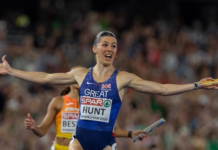

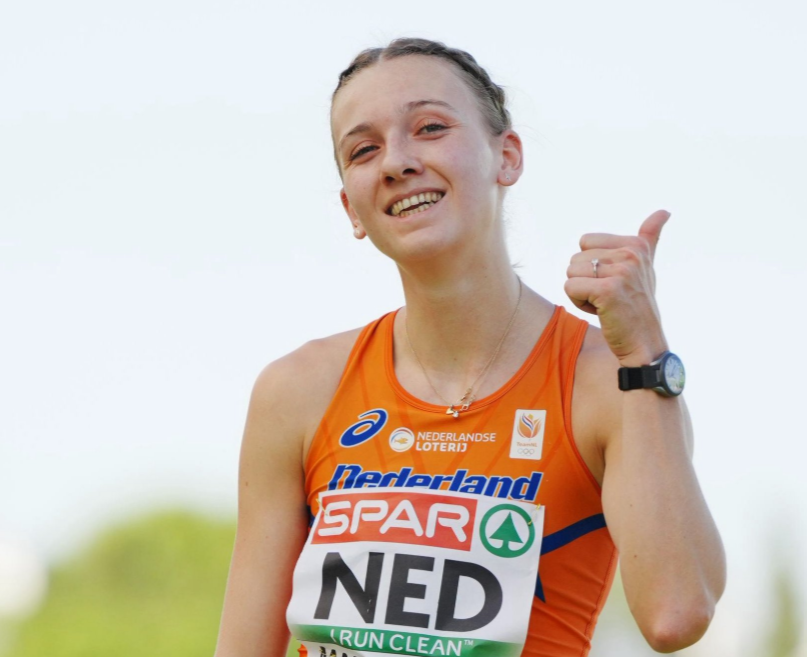
Can Keely Hodgkinson, Femke Broeders-Bol, or anyone else, for that matter, defeat Audrey Werro in the women’s 800 metres at the World Athletics Ultimate Championships, September 11 to 13?
Under normal circumstances, the Diamond League Final would be the next best thing to a World Championship or the athletics competition at the Olympic Games. This year, however, the inaugural Ultimate Championships arrive at the end of an extraordinarily long season, one that has already included the European Championships, Commonwealth Games, Diamond League circuit, and World Indoor Championships.
That matters.
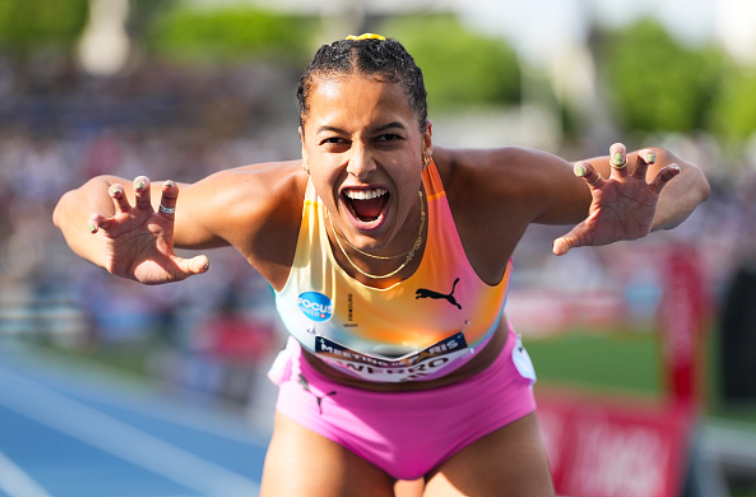
Audrey Werro is only 22, but she has raced 24 times this season. Racing approximately 20 times in a season is not unusual for a middle-distance runner, but there is a point where the accumulation of racing begins to matter. Athletes reach a peak, and once they do, maintaining that level of sharpness becomes increasingly difficult.
So the question is simple:
Has Werro already reached her peak?
If she has, Broeders-Bol has a chance.
If she has not, the rest of the field may simply be racing for second.
Werro’s remarkable season
Werro has run under 1:54 three times this season.
She won in Stockholm on June 7 in 1:53.98, then improved to 1:53.80 in Paris on June 28. On August 27 in Zürich, she ran 1:53.70, a personal best and the fastest 800-metre performance in 43 years.
The last woman to run faster was Jarmila Kratochvílová, who ran 1:53.28 in Munich in 1983.
Running under 1:54 once is extraordinary. Doing it repeatedly is something else entirely.
Werro is now the only athlete in history to have done it more than once. Nadezhda Olizarenko ran 1:53.43 in Moscow in 1980. Kratochvílová ran 1:53.28 in 1983. Neither did it twice.
The times from that era, of course, come with a considerable historical asterisk. Both Olizarenko and Kratochvílová competed during a period in which systematic doping was widespread in Eastern Bloc sport.
Several other athletes have come close without breaking 1:54.
Caster Semenya ran 1:54.25. Pamela Jelimo ran 1:54.01. Keely Hodgkinson, the Paris Olympic champion, is eighth on the all-time list at 1:54.33.
Hodgkinson will be in the Ultimate Championships field.
Werro has also run under 1:55 twice this season, clocking 1:54.45 in Ostrava and 1:54.81 at the European Championships in Birmingham.
Only 13 athletes have broken 1:54, doing so a combined 29 times. Five of those performances belong to Werro, three to Hodgkinson, and one to Broeders-Bol.
This is not merely a good season for Werro.
It is her breakout season.
Before 2026, her personal bests were in the 1:58 range, and most of her races were above 2:00. Now she is running times that have been almost impossible to produce for more than four decades.
And she has done it repeatedly.
That is why the biggest question surrounding Werro is not whether she is good enough to win.
It is whether she has anything left.
Broeders-Bol is coming
Even if Werro has passed her peak, she may still be unbeatable.
Broeders-Bol, however, is getting closer.
And unlike Werro, Broeders-Bol appears to be improving with every race.
She has raced 12 times this season, 11 of them over 800 metres and once as part of the Dutch 4 x 400-metre relay at the Birmingham European Championships.
This is her first season as an 800-metre runner after moving up from the 400-metre hurdles, 400 metres and 4 x 400-metre relay.
Her first 800 metres came indoors in February, when she ran 1:59.07.
She did not race the distance again until June, when she ran 1:57.13 in Ostrava and 1:57.41 in Hengelo.
Then came Paris.
Broeders-Bol ran 1:55.60, and suddenly the experiment looked considerably more serious.
She lost to Werro, but the gap was only 1.80 seconds. In Ostrava, Werro had beaten her by 2.58 seconds.
The gap narrowed again in Birmingham to 0.73.
Then came Brussels on September 5.
Werro won.
Broeders-Bol was second.
The difference?
Six hundredths of a second (0.06).
At one point, it appeared that if the race had been another 10 metres longer, Broeders-Bol might have gone past her.
That is a remarkable progression for an athlete in her first season over the distance.
And it creates an interesting dynamic heading into the Ultimate Championships.
Werro has raced twice as often.
Broeders-Bol is steadily improving.
Werro may have already reached her seasonal peak.
Broeders-Bol may not have found hers yet.
That makes her the most obvious threat to Werro.
She may finish the Ultimate Championships with officials reaching for the photo-finish image.
Or, if Werro is finally showing the effects of 24 races, Broeders-Bol could do more than make the finish close.
She could win.
Then there is Hodgkinson
Keely Hodgkinson was the best 800-metre runner in the world for much of 2024 and 2025.
Before becoming the champion, however, she was where Broeders-Bol is now: repeatedly finishing second.
Hodgkinson was second at the Tokyo Olympic Games in 2021, the World Championships in Eugene in 2022, the Birmingham Commonwealth Games in 2022, and the World Championships in Budapest in 2023.
Eventually, she stopped finishing second.
In 2024, she won Olympic gold in Paris.
Now she is back in a somewhat unfamiliar position.
Hodgkinson raced only six times in 2025, winning five. Her only loss came in a close race won by Kenya’s Lilian Odira in 1:54.62. Georgia Hunter Bell ran 1:54.90 and Hodgkinson 1:54.91.
It was hardly a collapse.
It was a race decided by 0.29 seconds.
Now, Werro has gone faster than Hodgkinson’s personal best, and Broeders-Bol has also run faster this season.
Broeders-Bol has not beaten Hodgkinson head-to-head.
That distinction matters.
At 24, Hodgkinson is in the middle of what should be her peak years. She has raced 16 times in 2026, somewhat more than usual for her, but then made a deliberate decision to stop racing after August 14, saying her body was not ready to compete again.
That could be a problem.
Or it could be exactly what she needed.
After a season in which she has raced considerably less than Werro, Hodgkinson arrives at the Ultimate Championships with several weeks away from competition.
Is she rested?
Is she sharp?
And is she ready to race through the final 100 metres against two athletes who have been running circles around the competition all season?
The answer is probably yes.
But if Werro has begun to fade and Broeders-Bol continues her trajectory, Hodgkinson could find herself in an unusual position.
Third.
The rest of the field
Prudence Sekgodiso of South Africa has had an up-and-down season.
The 24-year-old has raced 17 times over 800 and 1500 metres and ran a personal best 1:56.83 in Paris.
Since then, however, her results have been inconsistent.
Running slowly in a championship heat is hardly unusual, particularly during a long season. Sekgodiso twice ran well over 2:00 during the Commonwealth Games, but her most recent race in Brussels was 2:02.30.
She has run over 2:00 eight times this season and has also run well under it six times.
Which Sekgodiso shows up in the Ultimate Championships is anyone’s guess.
She will need to be close to the leaders with 200 metres remaining and then be prepared to suffer.
There is no other way into this race.
Rénelle Lamote of France, 32, set a lifetime personal best this season, running 1:56.93 in Paris.
That was an exceptionally fast race that appeared to drag several athletes to performances quicker than expected.
Lamote has raced only nine times this season; however, she should arrive relatively fresh.
She and Sekgodiso look like the most likely candidates for fourth and fifth.
Then there is Roisin Willis of the United States.
At 22, Willis has raced nine times this season, eight of those over 800 metres. She has broken 2:00 in every one of them and established a personal best of 1:57.56 in Stockholm.
She has not yet shown the kind of speed produced by Werro, Hodgkinson, or Broeders-Bol.
But that does not mean she cannot take another step forward.
Willis could find herself racing Lamote and Sekgodiso for fourth.
And if the leaders tire, she could find herself much closer to the medals than expected.
The prediction
On paper, Werro should win.
She has run 1:53 three times.
Nobody else in the field has done that once this season.
But this is not a normal championship at the end of a normal season.
Werro has raced 24 times.
Broeders-Bol has raced 12.
Hodgkinson has raced 16 times, but has had several weeks away from competition.
Those numbers make the race considerably more interesting than the season’s times suggest.
Werro has the best engine.
Broeders-Bol has the most obvious upward trajectory.
Hodgkinson has the championship pedigree.
If Werro is still at her best, she wins.
If she is even slightly diminished, Broeders-Bol may be the athlete ready to take advantage.
And if Hodgkinson has used her August break to recover rather than lose her racing edge, the Olympic champion could remind everyone why she spent several years being the woman nobody could quite beat.
My prediction?
Werro, Broeders-Bol, Hodgkinson.
But for the first time this season, I would not be particularly surprised if the order were different.
And that is what makes the women’s 800 metres one of the most interesting races of the inaugural Ultimate Championships.