
Title: The Long Run and the Decade That Made the Marathon Cool
Author: Martin Dugard
Publisher: Dutton. Penguin Randomhouse LLC
Published: 2026
Pages: 296
ISBN: 9798217178483 (Hardcover)
ISBN: 9798217178940 (ebook)
The review
The Long Run and the Decade That Made the Marathon Cool is more than a book about the running boom. It is a narrative journey through the roads, tracks, trails and cultural arteries that transformed distance running into something larger than sport. The focus settles primarily on the 1970s and early 1980s, an era that reshaped athletics in North America and beyond.
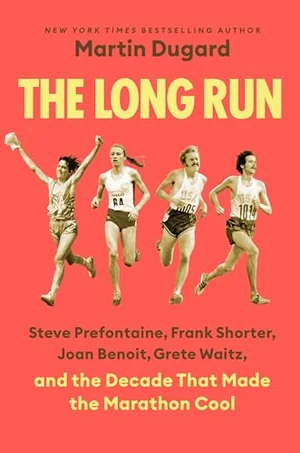
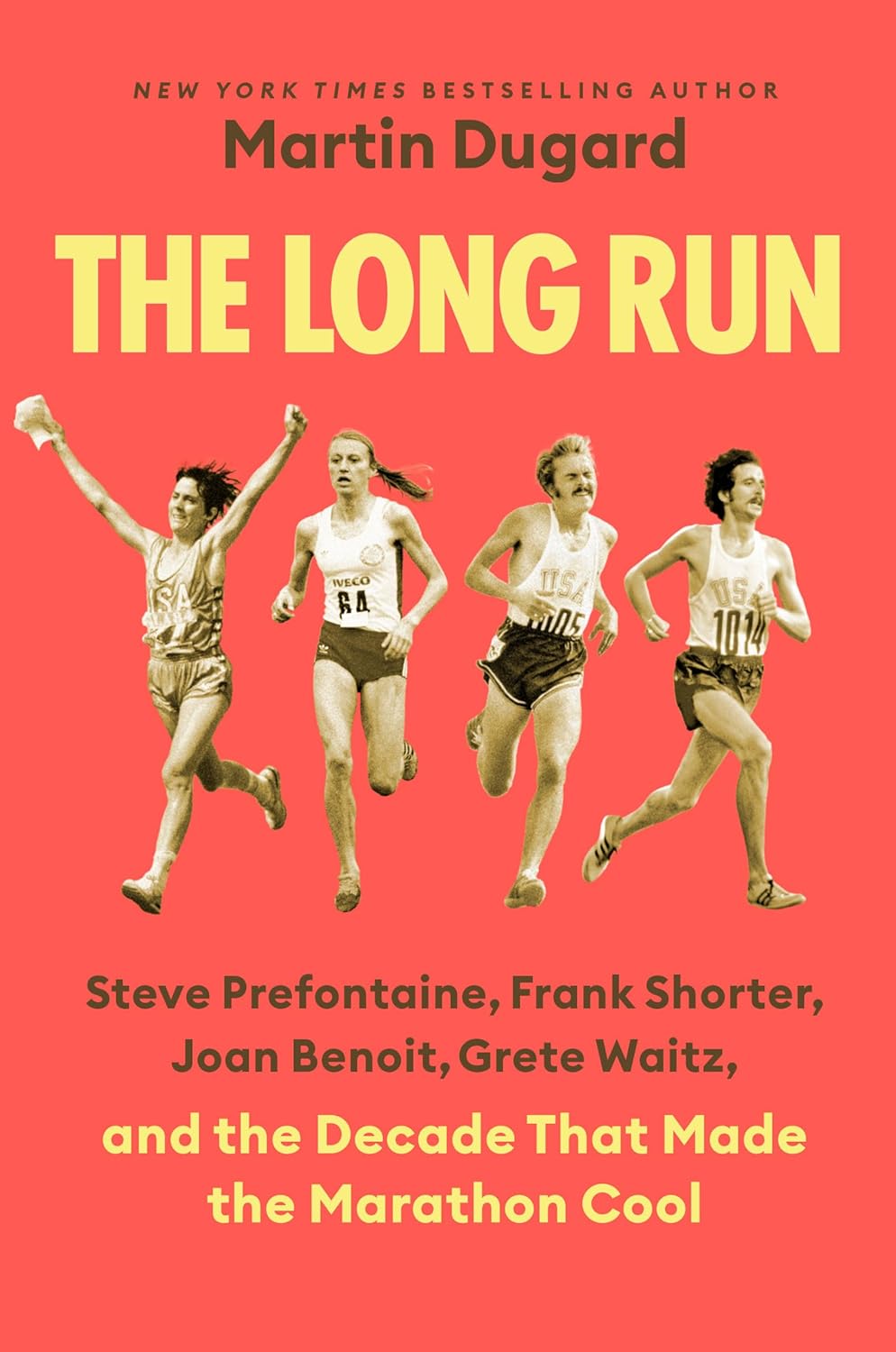
As illustrated on the cover, the icons are all there: Joan Benoit Samuelson, Frank Shorter and Grete Waitz. Steve Prefontaine, too, forever the restless spirit of American track and field, though he never had the opportunity to discover what his best may have looked like on the roads or even fully on the track. Dugard takes readers there anyway, into the stadiums, onto the streets and into the mythology.
The book works as both a history lesson and a cultural reflection. Most readers familiar with athletics will recognize many of the individual stories, yet Dugard succeeds in weaving them together into a cohesive era rather than isolated moments. The connective tissue matters.
Bill Rogers cannot be discussed without Frank Shorter. Shorter cannot be separated from Lasse Virén, and Prefontaine raced in that same orbit. Rogers and Shorter inevitably intersect with Grete Waitz, whose dominance eventually gave way to Joan Benoit Samuelson. Their stories overlap not merely chronologically but culturally. They belonged to the same movement.
Waitz, though Norwegian, played an outsized role in popularizing the New York City Marathon through her astonishing nine victories in ten years. Remarkably, she initially had little intention of becoming a marathon runner at all.
Her story remains among the most compelling in the book. Many readers may have assumed for decades that Waitz progressed naturally from cross country and track toward the marathon with deliberate ambition. Instead, her discovery of the distance feels almost accidental, even comedic in retrospect. Dugard wisely avoids overplaying the humour. His prose remains smooth, conversational and quietly confident, as though the author is speaking directly through the page; vox textus folia.
In 1970, only 127 runners appeared at the starting line of the inaugural New York City Marathon.
The entry fee was one dollar.
There was one woman.
Dugard begins appropriately in ancient Greece before moving through the modern Olympic movement, revisiting the mythology and reality surrounding Pheidippides, the original messenger whose story became inseparable from marathon lore.
From there, the narrative moves into the 20th century and eventually toward Eugene, Oregon, the spiritual centre of American distance running, where Nike co-founders Bill Bowerman and Phil Knight altered athletics culture forever.
Importantly, Dugard remembers Arthur Lydiard.
Too often forgotten in broader American retellings, the New Zealand visionary profoundly influenced Bowerman and modern endurance training itself. Bowerman once remarked to President John F. Kennedy: “I am but the messenger. Arthur Lydiard of New Zealand is the prophet.”
The book navigates through multiple tributaries of the running boom: the President’s Physical Fitness Award, fierce rivalries, and the explosion of running literature in the 1970s, including Jim Fixx’s The Complete Book of Running and Kenneth Cooper’s Aerobics.
Eventually, the narrative arrives squarely in the great running boom itself, the era of Samuelson, Prefontaine, Rogers, Shorter and Waitz.
There are omissions, naturally. Australian Robert de Castella, New Zealanders Rod Dixon, Lorraine Moller, Dick Quax and John Walker, Britain’s Ovett, Coe and Cram, along with Japan’s Toshihiko Seko, might have enriched the broader international context. Yet perhaps another 30 pages would have pushed the book beyond its intended stride length.
One curious editorial decision persists throughout. Dugard, or perhaps his editor, bypasses the conventional Chicago and Associated Press style rule of capitalizing “Games” when referring to the Olympic Games. A minor detail perhaps, but one noticeable to readers attentive to athletics journalism and publishing standards.
Still, The Long Run succeeds because it understands something essential. The marathon boom was never solely about running. It was about identity, aspiration, suffering, fitness, counterculture, commercialization and belief. The roads became crowded because, for a brief period, distance running represented possibility itself. I mean, if Oprah Winfrey will run the rolling Marine Corps Marathon in her debut instead of the dead flat Chicago, where her show was televised from for 25 years, the masses have to ante up.