

It was a cloudless afternoon, unusually warm for mid-September. At the Cimetière du Montparnasse in Paris, an international gathering stood before a grave that the running world had largely overlooked for more than a century.
On September 15, 2026, exactly 132 years after Michel Bréal’s famous letter to Pierre de Coubertin proposing a marathon race at the modern Olympic Games, the fully restored grave of the man widely regarded as the father of the marathon was officially unveiled. Approximately 40 guests attended the ceremony.
An honour never before bestowed
The Association of International Marathons and Distance Races (AIMS) has conferred the title of Founder Emeritus on Michel Bréal, marking the first time in the organization’s history that the distinction has been awarded.
AIMS represents approximately 470 of the world’s leading marathons and distance races across more than 120 countries.
“AIMS honours the historical origins of the marathon and works to ensure that Michel Bréal’s legacy is permanently recognized. It is therefore our intention to celebrate a worldwide Marathon Day every year on September 15,” said AIMS President Paco Borao.
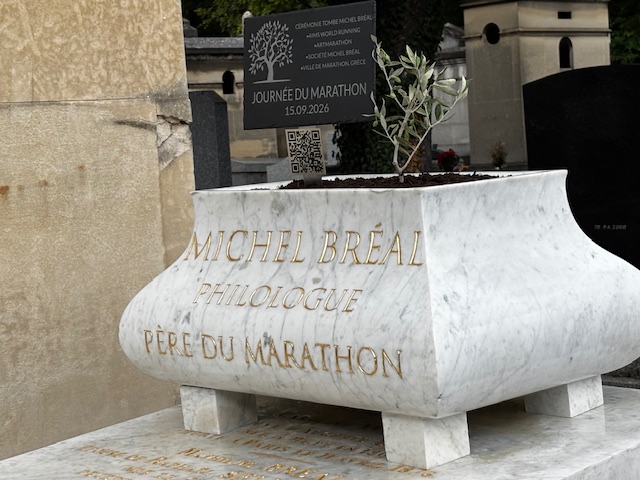
For the first time, the running community will have an annual date dedicated to the origins of the marathon. The inaugural worldwide Marathon Day will take place on September 15, 2027.
From a deteriorating grave to a lasting memorial
The condition of the Bréal family grave had deteriorated considerably. In 2012, AIMS and the international governing body for athletics, then known as the IAAF and now World Athletics, worked with the Michel Bréal Society to organize an initial rescue and partial restoration.
During a visit to Paris for the 2024 Olympic Games, representatives of the organizations again found the grave in poor condition. They agreed that a complete restoration was necessary.
The project was financed through a donation from AIMS and organized jointly with ARTMARATHON and the Michel Bréal Society. Stonemason Alain Buitrago carried out the restoration work, continuing on-site during the final weekend before the unveiling.
The restoration includes a new memorial stone and carefully executed, durable engravings. A QR code installed at the grave provides visitors with information about Bréal’s life and work. The project is intended to preserve the monument for decades to come.
Family remembers a man who never ran a marathon
The ceremony opened with welcoming remarks from Paco Borao, representing AIMS, and Prof. Heinz-Helmut Lüger, chairman of the Michel Bréal Society. Representatives of the City of Paris and the German Embassy in Paris were also in attendance.
Henrietta Parsons, Bréal’s great-great-granddaughter, spoke on behalf of the family. She offered a personal glimpse of a man whose teachers reportedly described him as a notorious sleeper.
Parsons knows her distinguished ancestor primarily through a portrait painted by his son Auguste, which hangs in her London kitchen. In the painting, Bréal sits at his desk, his feet not quite reaching the floor.
She connected Bréal’s academic achievements with his contribution to the origins of the marathon. He established semantics as an independent academic discipline and coined the term itself.
Around 490 BC, the word “Marathon” referred to little more than a fennel field. Bréal helped give it an entirely new meaning. Today, it represents an enduring test of human determination and perseverance, recognized around the world.
A Palatine in Paris, with student years in Berlin
Michel Bréal was born on March 26, 1832, in Landau in the Palatinate, then part of the Kingdom of Bavaria.
After studying at the École Normale Supérieure in Paris, he spent two years in Berlin, where he studied comparative grammar of the Indo-European languages under Franz Bopp and Sanskrit under Albrecht Weber.
In 1866, he became professor of comparative grammar at the prestigious Collège de France. As a founder of modern semantics, Bréal became one of the most influential linguists of his era.
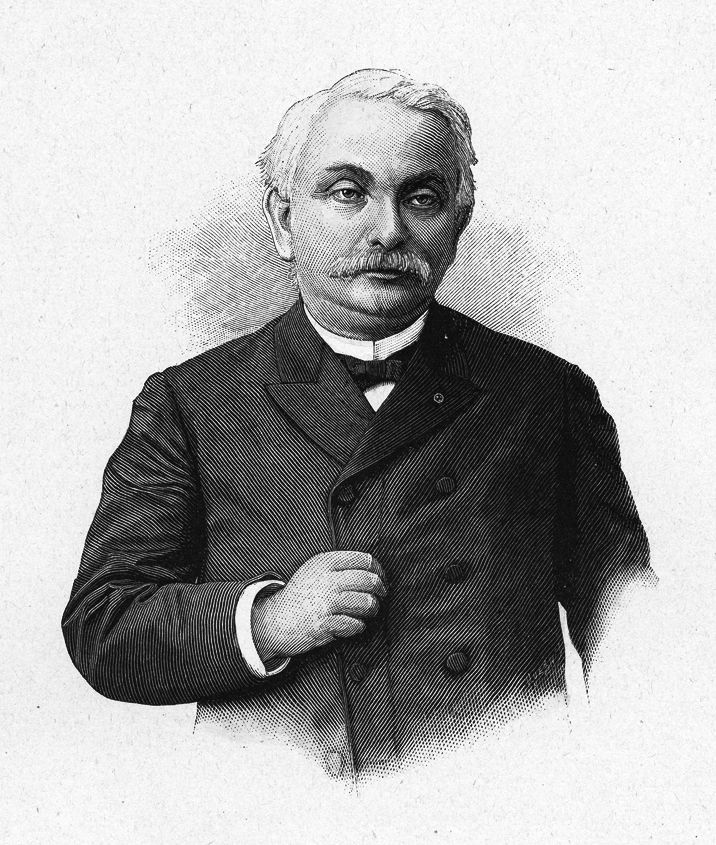
Michel Bréal (1832–1915), linguist at the Collège de France and the scholar whose idea became the Olympic marathon. Photo: Forum für Sportgeschichte Berlin, Marathoneum.
Bréal never witnessed the race from Marathon to Athens in person. On the day of the marathon at the 1896 Olympic Games, he remained in France and received the result by telegram.
The silver cup he donated was presented to Olympic marathon winner Spyridon Louis in Athens. The trophy was subsequently auctioned at Christie’s in London on April 18, 2012, for £541,250 and acquired for Greece by the Stavros Niarchos Foundation.
Michel Bréal died in Paris on November 25, 1915, and was buried at the Cimetière du Montparnasse. November 25, 2026, marks the 111th anniversary of his death.
“He became a Louis”: the marathon and Greece
Alexander Kitroeff, emeritus professor of history at Haverford College in Pennsylvania, spoke about the significance of the marathon to modern Greece.
He recalled the historic entrance of Spyridon Louis into the Panathenaic Stadium in 1896 and the Greek expression that remains in use today: “Έγινε Λούης” — literally, “He became a Louis.” The expression describes someone who runs so fast that they disappear from sight.
The ceremony was moderated by Benedikt Morandi of ARTMARATHON and Prof. Hans W. Giessen of the Michel Bréal Society. A press conference and viewing of the restored grave followed.
“No Bréal, no Berlin Marathon”
“We all must thank him…”
Under that heading, Horst Milde, founder of the Berlin Marathon and coordinator of the Marathoneum in Berlin, addressed the gathering.
At 88, Milde brought several perspectives to the occasion: those of a runner, a major race organizer and a longstanding representative of the international running community.
“Without his idea from 1894, I would not be standing here today,” Milde said.
He recalled that the Berlin Marathon began in 1974 with just 286 runners. Twelve days after the Paris ceremony, approximately 56,000 marathoners took to the streets of the German capital.
Everyone involved in running, Milde argued, owes Bréal an enormous debt of gratitude — from individual runners to organizers of the smallest village races. The same applies to the organizations and industries that support the sport, including medicine, science, media, tourism and business.
Milde also highlighted the marathon’s anticipated return to its historical birthplace. Beginning in 2030, World Athletics plans to stage separate World Marathon Championships. Athens is considered the preferred host for the inaugural edition, with formal discussions underway.
His own connection with Greece stretches back many years. From 2007 to 2019, Milde led the AIMS Marathon Symposium, initially in the town of Marathon and later in Athens. He also advised the Athens Marathon for several years.
At the ninth AIMS World Congress, held in Macau on December 6–7, 1994, Milde introduced the proposal that led to the establishment of an AIMS Marathon Museum of Running in Berlin. That initiative eventually developed into today’s Forum für Sportgeschichte Marathoneum Berlin.
Crémant, cake and a master pastry chef from Berlin
Following the ceremony, guests enjoyed Crémant d’Alsace, with a specially designed label created by Henrietta Parsons.
Dinner brought another surprise and revealed a little-known side of the Berlin guest of honour. Horst Milde presented a specially created “Bréal cake,” made by French colleagues in Paris.
Milde is also a master pastry chef. Together with his wife, Sabine, he operated the third-generation family bakery and pâtisserie in Berlin, originally established by his grandparents in 1903.
The couple met while studying at the Free University of Berlin. Milde graduated in business administration, while Sabine trained as a teacher of commercial subjects.
“We wanted to give you a taste of the other side of our life as well,” Milde said in Paris.
International response
The ceremony received international attention. AIMS magazine Distance Running devoted a double-page spread to the event in its 2026 issue 4, while sports historian Roger Robinson helped bring the occasion to a wider audience through social media.
The Michel Bréal Society has now published a 20-page documentation of the restoration project and memorial ceremony. The publication includes the complete texts of the addresses delivered at the event, together with numerous photographs.
“Michel Bréal is finally receiving the recognition he has deserved for a very long time,” said Milde. “And every year, September 15 will remind the world of his idea.”
***
Michel Bréal – Portrait – Photo: Forum for Sports History, Berlin – Courtesy of
The restored Bréal family tomb—Horst Milde—courtesy of the author.
The upper section featuring the small olive tree from Greece—Horst Milde—courtesy of the author.