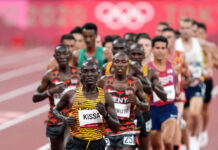

In 2021, sprint legend Usain Bolt came to the defence of Grace Kennedy Boys Athletics Championships 200 metre winner Antonio Watson. Watson had pointed a finger gun (left image) at his competitor. Bolt recommended that authorities reason with the athlete and work with and mould him. Bolt, himself, had previously been criticized for showboating by beating his chest at the finish line.


Botswana’s Tshepiso Masalela (right image) was stripped of a victory in the men’s 1500m at the Orlen Copernicus Cup in Toruń, Poland, on Sunday.
The decision to DQ Masalela has been met with both criticism to athletics authorities and support.
Sportsmanship has always prevailed in athletics. However, celebration is, especially in the sprints, standard fare.
For example, multi-time World and Olympic champion for Great Britain Mo Farah celebrated with the MOBOT gesture. American sprinter Maurice Greene was known for his tongue-out showboating. American sprinter Noah Lyles has pointed his index finger at competitors.
World Athletics rules
World Athletics enforces strict, codified rules regarding sportsmanship and conduct on the track to ensure fair play, safety, and respect among competitors. These are primarily covered under the Technical Rules (Rule 6) regarding “Improper Conduct.”
- Misconduct and Unsportsmanlike Behaviour (Rule 6.3)
Definition of Misconduct: Athletes who act in an unsportsmanlike manner—including taunting, profane language, or obscene gestures—can be disqualified.
Disqualification: If an athlete is acting in a manner that is deemed “unsporting” or “improper,” the referee has the authority to disqualify them from that event.
Prohibited Gestures: Celebrations that are deemed provocative, such as certain finger-gun gestures, can lead to disqualification, as they are considered against the spirit of fair competition. - Starting Line Etiquette and Conduct
Aborting the Start: An athlete who deliberately causes a start to be aborted (e.g., holding up a hand, standing up, or making noise after being in the “set” position) without a valid reason (like crowd noise or external interruption) may receive a yellow card for improper conduct.
Disturbing Others: Any action that interferes with the concentration of fellow athletes during the starting process is a violation. - Fair Play and Competition Integrity
Physical Interference: Athletes must not deliberately obstruct or push another runner. Doing so violates the core principle of fair play.
Assistance to Athletes: Athletes are forbidden from receiving prohibited assistance from others (e.g., being paced by someone not in the race).
Doping and Integrity: “Fair play” fundamentally requires competing without the use of illegal performance-enhancing drugs. - Technical Rules Governing Conduct
Reporting to the Call Room: Failing to report to the Call Room on time is considered a procedural infraction and, unless there is a justifiable reason, will lead to the athlete being marked as DNS (Did Not Start).
Respect for Officials: Athletes are expected to comply with the instructions of officials and accept their decisions without aggressive argument.
Agents and coaches should mentor young athletes on appropriate behaviour. It simply comes down to one conversation, once in the career of the athlete.