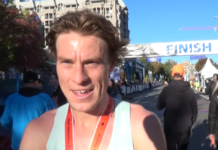

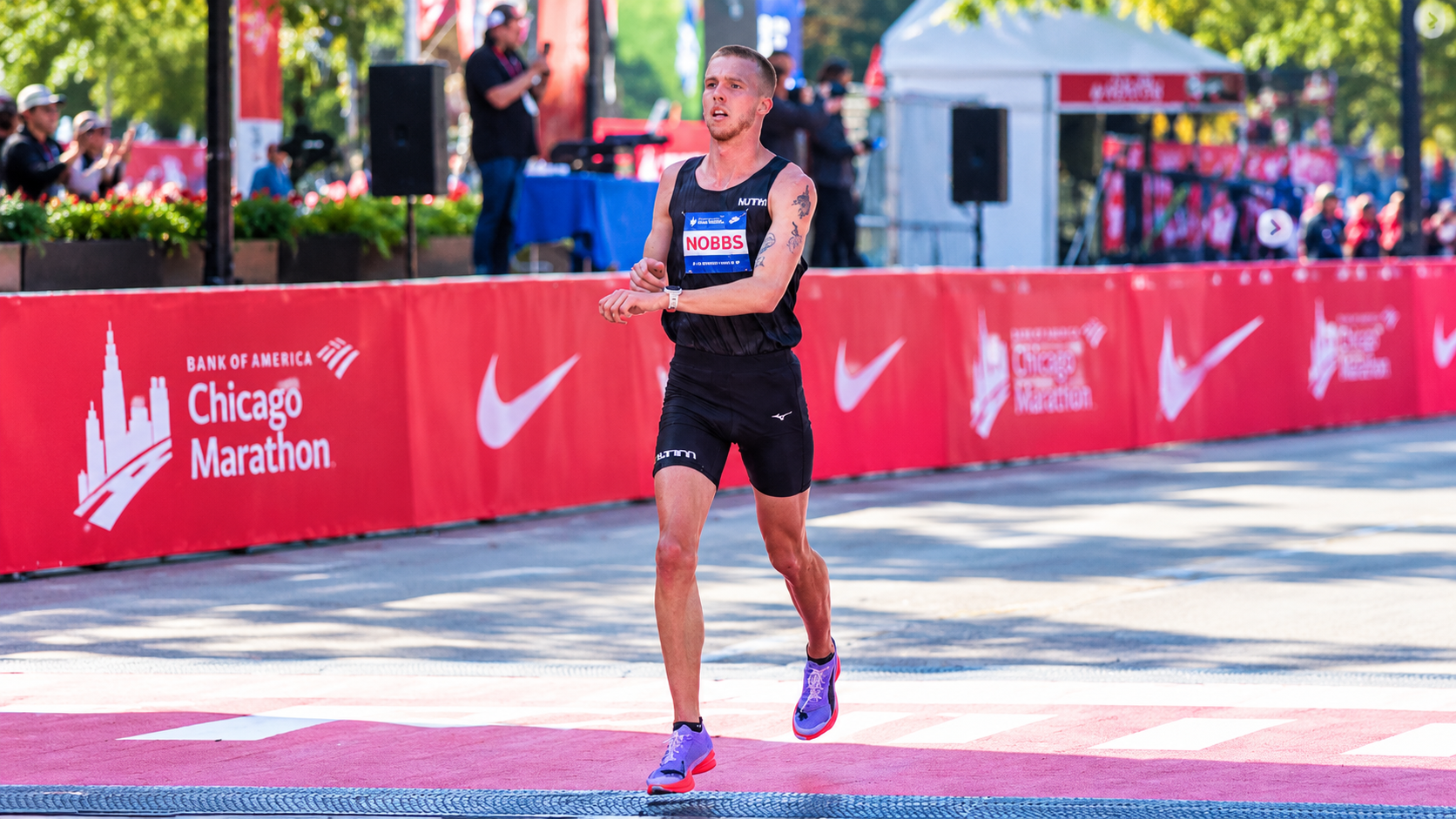
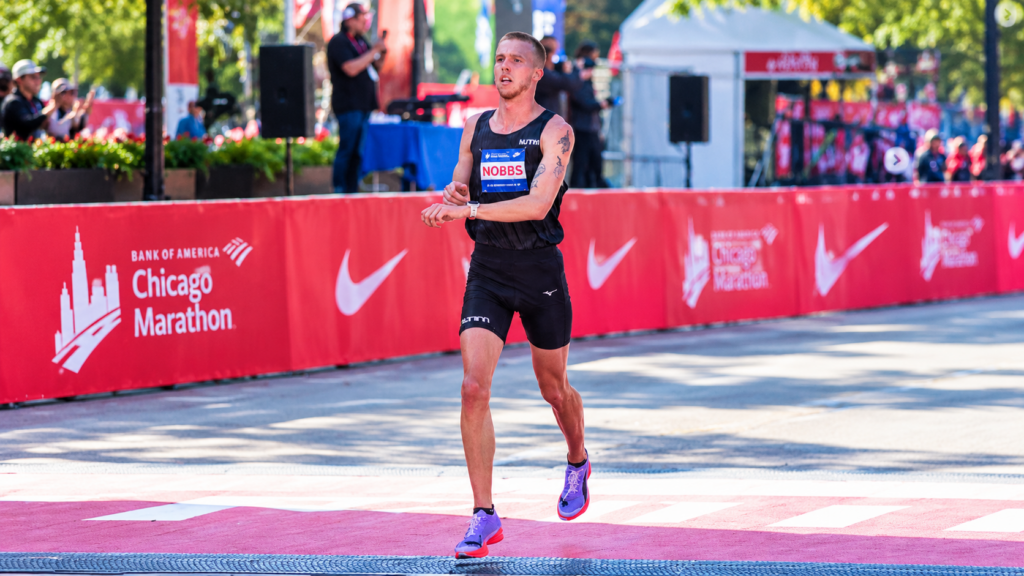
Canadian distance runner Thomas Nobbs of Vancouver, B.C., ran a 50-second personal best of 2:08:35 at the 2026 Chicago Marathon, overcoming warm temperatures and late-race cramping.
The 27-year-old passed halfway on pace for approximately 2:07:20 and reached 20 miles (32 km) on track for 2:07:07 before finishing 17th in a deep international field. Kenya’s Amos Kipruto won in 2:01:09, tying former world record-holder Eliud Kipchoge for the fifth-fastest marathon performance in history.
Nobbs broke 2:10 for the first time in March, running 2:09:25 at the McKirdy Micro-OTQ at Rockland Lake State Park in Congers, N.Y. He now ranks third among Canadians on the all-time list, behind Cameron Levins (2:05:36, Tokyo, 2023) and Rory Linkletter (2:06:49, Chicago, 2025). Linkletter also ran 2:08:01 in Zurich in 2024, while Levins has recorded 2:06:49 in Tokyo in 2026 and 2:07:09 at the 2022 World Athletics Championships in Eugene, Oregon.
A University of British Columbia alumnus, Nobbs had no early ambition to become a marathoner. His coach, Brant Stachel, suggested the distance in 2024 as part of a longer-term plan. The question is on his mind: how much faster could he have run in cooler temperatures with no late race cramping. We may find out soon.
Personal bests
| Event | Time | Date | Location |
|---|---|---|---|
| Marathon | 2:08:35 | 11 Oct 2026 | Chicago, IL, USA |
| Half Marathon | 1:03:06 | 22 Mar 2025 | Rockland Lake State Park, Congers, NY, USA |
| 10 km Road | 28:47 | 23 May 2026 | Ottawa, Canada |
| 10,000 Metres | 29:18.72 | 3 Jun 2026 | Alumni Stadium, Guelph, Canada |
| 5000 Metres | 14:12.58 | 31 Oct 2020 | Rashpal Dhillon Oval, Vancouver, Canada |
The interview
Christopher Kelsall: Congratulations on your personal best at the Chicago Marathon on Sunday. Running 2:08:35 must have been bittersweet, given the leg cramp and warm temperatures, knowing you could have run faster. How are you feeling today?
Thomas Nobbs: Thank you for the kind words. Running in Chicago was a big, lofty dream of mine for the longest time, and I am thrilled with the experience. I am reminding myself to be grateful for the progress I am making, to come away with a PB, and to move up on the all-time list. With that being said, even right after the race, I didn’t feel completely spent, which was very frustrating. From cramping and having to stop for 25-27 seconds at 40k, then easing back into 3:05-3:12/km the last 2km trying to ensure my hamstring didn’t give out again, I wish I had been able to kick harder and empty the tank on the course to know I had gotten the most out of myself and given my utmost effort.
Twenty-four hours post-race, I was going for an 80 min run on Monday. This may also be more a function of how quickly I recover and my level of durability, or due to my proper fuelling within the race.
CK: Was your initial reaction disappointment, or were you philosophical about the result, knowing you’re capable of more right now?
TN: The waves of emotion after a marathon are pretty intense. It was both a sense of relief to have made it past the finish, excitement about the time, but also frustration with myself for not controlling this variable on race day. As I said, we have to be pleased with progress, and I will use this as a very powerful motivator for my next training block.
CK: Given the cramping and temperatures, do you think 2:06-mid to 2:06-high was within reach on the day?
TN: I think we were on pace to comfortably run 2:07-mid, and I had full confidence that I was capable of that time on the day. I also still believe I am in shape to run 2:07-2:06 in my next marathon following appropriate recovery and a subsequent build. Naturally, we don’t know what would have happened in ideal weather, but by 33- 34 km we were still on that projected pace, and in workouts across the build, I have been able to close hard in the last 10 km within 30 km of marathon-specific work, so I do wonder if I could have maintained pace or pushed harder and faster in the last 10 km at Chicago.
CK: You’ve had an exceptionally consistent training year, with most weeks between 200 and 245 km. How has the quality of your training evolved as you’ve approached racing?
TN: This was definitely the highest mileage I have ever done. I think across my last marathon build to McKirdy, I was able to handle much more intensity (quality) with bigger sessions at Vo2 (i.e. 12 x 1 km @ 10 km + 6 x 400 at 5 km) within a regular training week.
With this build, I was able to do the same amount of intensity or more within a given workout but was recovering faster between sessions to be able to hit quality days (workout days) more often, while doing 230-235 km (140-143 miles) weeks, and simultaneously fitting in quality long runs with a lot of time at marathon pace or faster.
CK: I remember watching you race as a young teenager before you won the BC High School Championships in Kelowna. Did you envision becoming a marathoner back then, or were you focused on making the UBC Thunderbirds team?
TN: Ha! Never did I think I would become a marathoner until I was much older (in my 30s). Most of high school, I ran very low volume, and although I prided myself on being a tough runner, I always thought I would stick to shorter events with the 1500, steeplechase, and maybe the 5 km.
Introducing the marathon was entirely the idea of my coach, Brant Stachel. And it was his idea to introduce me to the event at a younger age to gain experience in the lead-up to future Olympic cycles. Without him, I would have been burnt out from the 5 km and 10 km or would have never gotten to where I am today.
CK: Did those early injuries help develop the focus and resilience that now drive your training at a world-class level?
TN: I’d say that from experiencing the highs and very low lows of this sport and my history of injuries before 2019, I have learned to use adversity as a source of ‘fuel’ and motivation in training. I love being an underdog and having a chip on my shoulder and grinding through long training blocks with the goal of proving to myself that I can keep getting better. I don’t think the injuries made me a good runner, but believing I was still the most resilient runner or one of the hardest-working runners regardless of past injuries has paid off many times over in helping me get to where I am today.
CK: Do you ever run without a watch, or at least avoid looking at it? And what about music? Old-school runners might say, “No; never,” to listening to music while running, but it seems common today.
TN: I had a coach in university who said that every mile you run while listening to music doesn’t count. It still makes me laugh.
I do run with a GPS watch daily and make my training public on Strava. On easy runs, I tend to avoid looking at the watch as much as possible and try to find the right ‘feeling’ for an easy run.
One notable thing I’ve started doing in this block is that I stopped wearing a heart rate monitor in all workouts, especially long run workouts, and have enjoyed that immensely. I’ve also run the best long run workouts of my life within this block by going off of effort first and pace as a close secondary data point.
CK: Which shoe model were you wearing in Chicago?
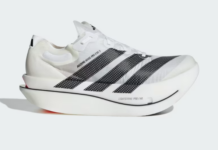
TN: Puma Fast R 3 – Pink and Purple
CK: How much of your overall training mileage do you run in super shoes?
TN: Basically, any work that is marathon pace or faster is in some kind of carbon-plated shoe.
CK: Ottawa can be hot and humid in summer. Did that climate help prepare you for Chicago’s temperatures of more than 20°C?
TN: No – the past six weeks in Ottawa were, for the most part, colder than Chicago’s race day temperatures. I did spend considerable time in the Sauna in this build and believe that helped, but it’s a fine line between getting the physiological benefits and not overcooking yourself with any sauna protocol.
CK: Are you targeting a spring marathon such as London or Tokyo, or considering Valencia or The Marathon Project in December?
TN: To be determined, but we will be aiming to run 1-2 minutes faster at the next marathon; I can promise you that.
Splits
| Split | Time Of Day | Time | Diff | min/mile | miles/h |
|---|---|---|---|---|---|
| 05K | 07:45:07AM | 00:15:07 | 15:07 | 04:52 | 12.33 |
| 10K | 08:00:05AM | 00:30:05 | 14:58 | 04:49 | 12.47 |
| 15K | 08:15:11AM | 00:45:12 | 15:07 | 04:52 | 12.34 |
| 20K | 08:30:21AM | 01:00:21 | 15:09 | 04:53 | 12.30 |
| HALF | 08:33:40AM | 01:03:40 | 03:19 | 04:53 | 12.29 |
| 25K | 08:45:20AM | 01:15:20 | 11:40 | 04:49 | 12.48 |
| 30K | 09:00:24AM | 01:30:24 | 15:04 | 04:51 | 12.38 |
| Mile 20 | 09:06:59AM | 01:37:00 | 06:36 | 04:53 | 12.32 |
| Mile 21 | 09:12:00AM | 01:42:01 | 05:01 | 05:01 | 11.96 |
| 35K | 09:15:43AM | 01:45:43 | 03:42 | 04:56 | 12.16 |
| Mile 22 | 09:17:01AM | 01:47:01 | 01:18 | 05:14 | 11.49 |
| Mile 23 | 09:22:02AM | 01:52:02 | 05:01 | 05:02 | 11.96 |
| Mile 24 | 09:27:05AM | 01:57:05 | 05:03 | 05:04 | 11.88 |
| 40K | 09:31:45AM | 02:01:45 | 04:40 | 05:26 | 11.06 |
| Mile 25 | 09:32:29AM | 02:02:29 | 00:44 | 05:15 | 11.44 |
| Mile 25.2 | 09:33:34AM | 02:03:34 | 01:05 | 05:18 | 11.34 |
| Finish | 09:38:35AM | 02:08:35 | 05:01 | 04:56 | 12.20 |