
© Copyright – 2026 – Athletics Illustrated
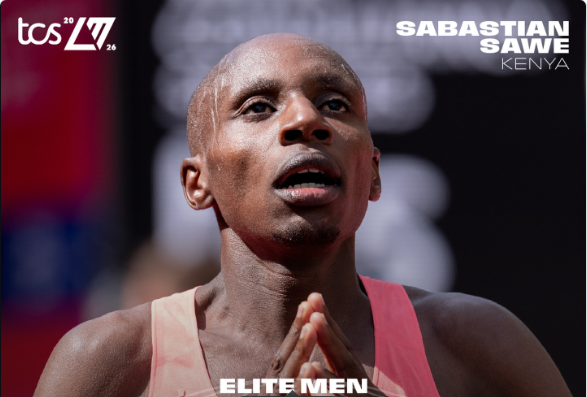
Sabastian Sawe didn’t just win the London Marathon, he shattered the limits of belief.
A 55-second world record obliteration. A clean break of the two-hour barrier by 30 seconds. Four men, in a single race, running faster than what was, until very recently, considered the outer edge of human endurance.
We are being asked to accept this as progress.
Should we?
For more than a decade, the sub-two-hour marathon has been treated as this sport’s final frontier. So elusive that Eliud Kipchoge required a laboratory-like, pacer-rotating, laser-guided exhibition just to dip under it unofficially. Even then, it wasn’t recognized as a record.
Now two men in one race?
Sawe leads the charge in 1:59:30. Ethiopian Yomif Kejelcha ran 1:59:41 in his debut—his debut! Ugandan Jacob Kiplimo goes 2:00:28, seven seconds under Kiptum’s world record. Kenyan Amos Kipruto clocks 2:01:39, a time that used to define greatness, now relegated to fourth place.
That isn’t evolution. That’s a discontinuity.
And when performance leaps that far, that fast, history tells us to ask questions, not applaud blindly.
Because distance running does not exist in a vacuum. It exists in a sport with a long, uncomfortable relationship with doping. Kenya sits at the centre of that story.
Hundreds of Kenyan athletes have been banned. Not dozens. Hundreds. Numbers that would decimate other nation’s programs. When Canada’s Ben Johnson was caught doping, there was a national inquiry that dragged on through the court of public opinion as a terrible reminder of shame. One man. That’s it. Nearly 40 years later, it continues to be referenced as a hall of shame failure.
This isn’t a perception problem. It’s a pattern.
And the present isn’t any cleaner than the past. Ruth Chepngetich, the current women’s world record holder, didn’t just test positive. She was reportedly found with a masking agent at 140 times the allowable limit. That’s not a mistake. That’s not contamination. That’s something else entirely.
So when London produces four historically unprecedented performances in a single morning, the burden of proof doesn’t sit with skeptics.
It sits with the sport.
The Athletics Integrity Unit offers a familiar defence: more testing leads to more positives. Fine. But that logic cuts both ways; it also suggests a deeper pool of doping to uncover. Testing doesn’t create a problem; it exposes one. If you are not doping, you don’t get caught.
Let’s also not pretend governance has been airtight. As recently as 2025, Kenya was on the brink of a national ban for failing to meet anti-doping standards. A late corrective plan bought time, and by early 2026, the country was removed from the immediate watchlist. Still, it remains under the highest level of scrutiny—Category A.
That’s not a technicality. That’s a warning label.
So what are we left with?
The optimists will point to technology: carbon-plated shoes, refined fuelling, better pacing, bi-carb. All true, and all incremental. None of it explains a mass breakthrough that collapses a barrier long treated as nearly insurmountable.
At some point, “innovation” becomes a convenient umbrella for things we don’t yet understand, a distraction or something we aren’t yet catching.
Which leads to an uncomfortable but unavoidable conclusion: either anti-doping systems are missing something significant, or we are witnessing a transformation so extreme it borders on the implausible.
Neither scenario should make anyone comfortable.
And yet, the sport rolls on, eager to celebrate.
Further back, Mahamad Mahamad’s 2:06:14 led the British contingent. Patrick Dever was the top British-born finisher in 2:16:18. Solid performances, but effectively erased by the scale of what happened in front of them.
Debates about nationality transfers, with World Athletics recently blocking 11 athletes from switching allegiance, feel peripheral. But saying that, Mahamad did move from Ethiopian to British citizenship through the correct processes, as a teenager.
Today, Sunday, April 26, is about whether the performances themselves can be trusted.
Women’s Race
The women’s race offered more of the same: fast times, falling records, and familiar questions.
Tigst Assefa won in 2:15:41, lowering her own women’s-only world record. Hellen Obiri and Joyciline Jepkosgei followed closely behind. It marks the third straight year London has delivered record-level results. The performances are believable.
Because the absolute world record, in a mixed race, belongs to Ruth Chepngetich, whose doping case remains impossible to ignore when evaluating the credibility of the event as a whole.
This is where marathon running now finds itself.
Times are dropping at a rate that should thrill us. Instead, they force a choice: suspend disbelief, or confront the possibility that the sport is once again ahead of its own integrity systems.
London didn’t just break records.
It exposed a fault line.
And until that’s addressed honestly, every extraordinary performance will come with the same, unavoidable question:
Should we believe what we’re seeing?
Results
Men
| Pos. | Athlete | Country | Time |
|---|---|---|---|
| 1 | Sabastian Sawe | KEN | 1:59:30 |
| 2 | Yomif Kejelcha | ETH | 1:59:41 |
| 3 | Jacob Kiplimo | UGA | 2:00:28 |
| 4 | Amos Kipruto | KEN | 2:01:39 |
| 5 | Tamirat Tola | ETH | 2:02:59 |
| 6 | Deresa Geleta | ETH | 2:03:23 |
| 7 | Addisu Gobena | ETH | 2:05:23 |
| 8 | Geoffrey Kamworor | KEN | 2:05:38 |
| 9 | Peter Lynch | IRL | 2:06:08 |
| 10 | Mahamed Mahamed | GBR | 2:06:14 |
| 11 | Patrick Dever | GBR | 2:06:18 |
| 12 | Joshua Cheptegei | UGA | 2:06:39 |
| 13 | Weynay Ghebresilasie | GBR | 2:06:59 |
| 14 | Jack Rowe | GBR | 2:07:47 |
| 15 | Amanal Petros | GER | 2:08:31 |
| 16 | Philip Sesemann | GBR | 2:08:41 |
| 17 | Tim Vincent | AUS | 2:09:41 |
| 18 | Adam Lipschitz | RSA | 2:09:53 |
| 19 | Tewelde Menges | GBR | 2:10:48 |
| 20 | Alfie Manthorpe | GBR | 2:11:31 |
Women
| Pos. | Athlete | Country | Time |
|---|---|---|---|
| 1 | Tigst Assefa | ETH | 2:15:41 |
| 2 | Hellen Obiri | KEN | 2:15:53 |
| 3 | Joyciline Jepkosgei | KEN | 2:15:55 |
| 4 | Degitu Azimeraw | ETH | 2:19:13 |
| 5 | Catherine Reline Amanang’ole | KEN | 2:21:20 |
| 6 | Eunice Chebichii Chumba | BRN | 2:23:44 |
| 7 | Eilish McColgan | GBR | 2:24:51 |
| 8 | Julia Paternain | URU | 2:25:47 |
| 9 | Rose Harvey | GBR | 2:26:14 |
| 10 | Marta Galimany | ESP | 2:27:38 |
| 11 | Louise Small | GBR | 2:28:29 |
| 12 | Jessica Warner-Judd | GBR | 2:29:28 |