

© Copyright – 2026 – Athletics Illustrated
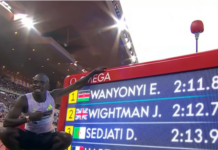
World Athletics is removing the marathon from the World Athletics Championships. A World Athletics spokesperson told CBC Sports the marathon is being moved to conditions where it can thrive, and expanding World Athletics’ presence in the broader running ecosystem.” Climate change, the spokesperson stressed, is a driving force behind the decision.
Canada’s Malindi Elmore disagrees
Canada’s second-fastest all-time marathon runner, Malindi Elmore, told the CBC, “It’s a special experience and something athletes work hard for,” she said, “I think this proposed change is essentially ‘shuffling’ it away and burying it in a major mass participation marathon.”
While World Athletics cites climate change as a major factor, economics likely play a significant role as well. Unlike stadium events, championship marathons are difficult to monetize directly. The courses are too expansive to generate substantial ticket revenue, and broadcasts can stretch close to three hours.
Integrating the championships into existing mass marathons changes the equation entirely. Major city marathons already generate millions through entry fees paid by tens of thousands of recreational runners. Events in New York, London, Chicago, Berlin and Boston use that model to support elite competition at the front of the race.
There is also validity to the climate argument. Summer championship marathons often produce difficult racing conditions that prioritize tactics over time-based performance. But the marathon remains one of athletics’ flagship events, and removing it from the World Athletics Championships risks diminishing part of the sport’s identity.
It was starting around the 2012 London Olympic Games that World Athletics and the IOC seriously considered removing the 10,000m event. At the time, it did not seem fair, as swimming, for example, has many more events. Several that seem nearly the same for the uninitiated.
The Diamond League already pared down its events to include middle distance, throws and jumps into a tidy, broadcastable length of time.
It is the cost of doing business
While profitability is important in sport, some events in some sports are part of the investment to put on a show. For example, preliminary rounds in games like international tennis, hockey and basketball are typically attended by fewer spectators and viewed by a smaller audience online if broadcast/streamed at all. Its the cost of doing business.
Alternatively, watching sprinters pull up multiple times during preliminary rounds, to not put out too much effort, is as boring as watching paint dry.
“Many city venues are simply too hot during the summer months to host marathons that attract the best athletes,” said the spokesperson. “We are considering a standalone autumn [marathon] championships that would combine the best elite athletes with our age groupers and mass participation runners.”
World Athletics published a press release saying the organization has “outlined a landmark strategic roadmap for the future of distance running with the creation of a World Athletics Marathon Championships from 2030.
“The marathon will remain a discipline at the World Athletics Championships in 2027 and 2029, but from 2030 it will move to its own standalone championships. From 2031 onwards, the marathon – or any other road running distance – will no longer form part of the World Athletics Championships.
“The World Marathon Championships will become an annual event, with men and women competing in alternate years, at the same frequency as the current World Championships marathon. It is a championship conceived in close partnership with those who have made the marathon the global phenomenon it is today, with full details of those partnerships to be announced in the coming months.”
A solution
One possible solution would be a championship “gender chase” format.
Rather than staging separate men’s and women’s marathons on different days, organizers could start the women first, followed by the men based on the historical performance gap between elite men and women. Currently 10:26 using world record standards.
With the men’s world record at 1:59:30 and the women’s world record at 2:09:56, the gap is 10 minutes and 26 seconds.
Such a format could create a compelling single-race broadcast while reducing operational costs tied to road closures, volunteers, officials and production time. The first athlete across the line, regardless of gender, could even receive an additional championship honour. If presented thoughtfully, the gender race could add drama and provide a compelling competition, where women and men do not typically compete.
1:59:30 =7170 seconds
2:09:56 = 7796 seconds
Difference:
7796−7170=626 seconds
2:09:56 is approximately 8.73% slower than 1:59:30.
(Or equivalently, 1:59:30 is about 8.03% faster than 2:09:56, since the percentage depends on which time you use as the baseline.)
The most recent World Championships saw the men’s winner run 2:09:48 and the women’s winner clocked 2:24:43. There is a 2:09:48 = 7,788 seconds
2:24:43 = 8,683 seconds
10.31% or 11.49% difference, depending on which baseline is used.
Finally, if need be, a mass participation marathon could, in theory, be added, or World Athletics could charge a premium to applicants for the privilege to participate in the World Athletics Championships and keep the mass-sized field from being too large and manageable.
At the end of the day, the marathon, 10,000m, and long racewalks should continue to be a part of the World Athletics Championships as the sport of athletics’ flagship event includes the marathon.