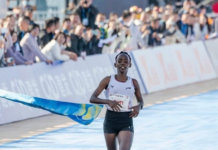

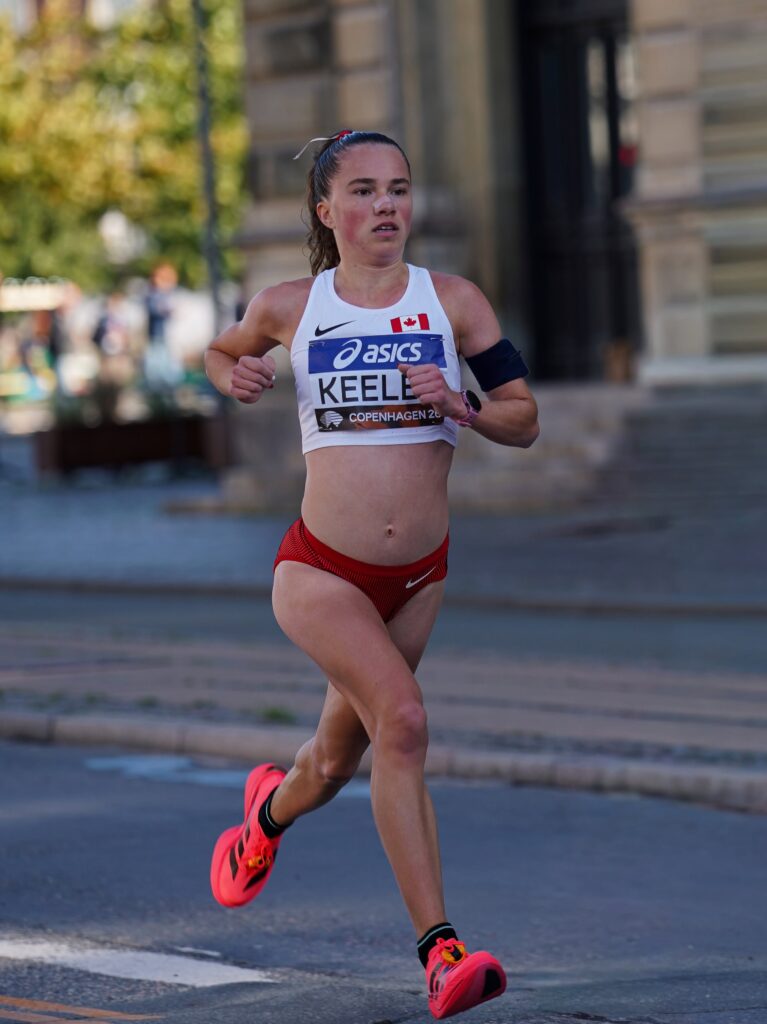
Twenty-three-year-old Jadyn Keeler of Barrie, Ontario, broke the Canadian half-marathon record at the 2026 World Road Racing Championships in Copenhagen, clocking 1:08:03 in just her second race at the distance. Her only other half-marathon was a win at the national championships in Edmonton, Alberta on August 16.
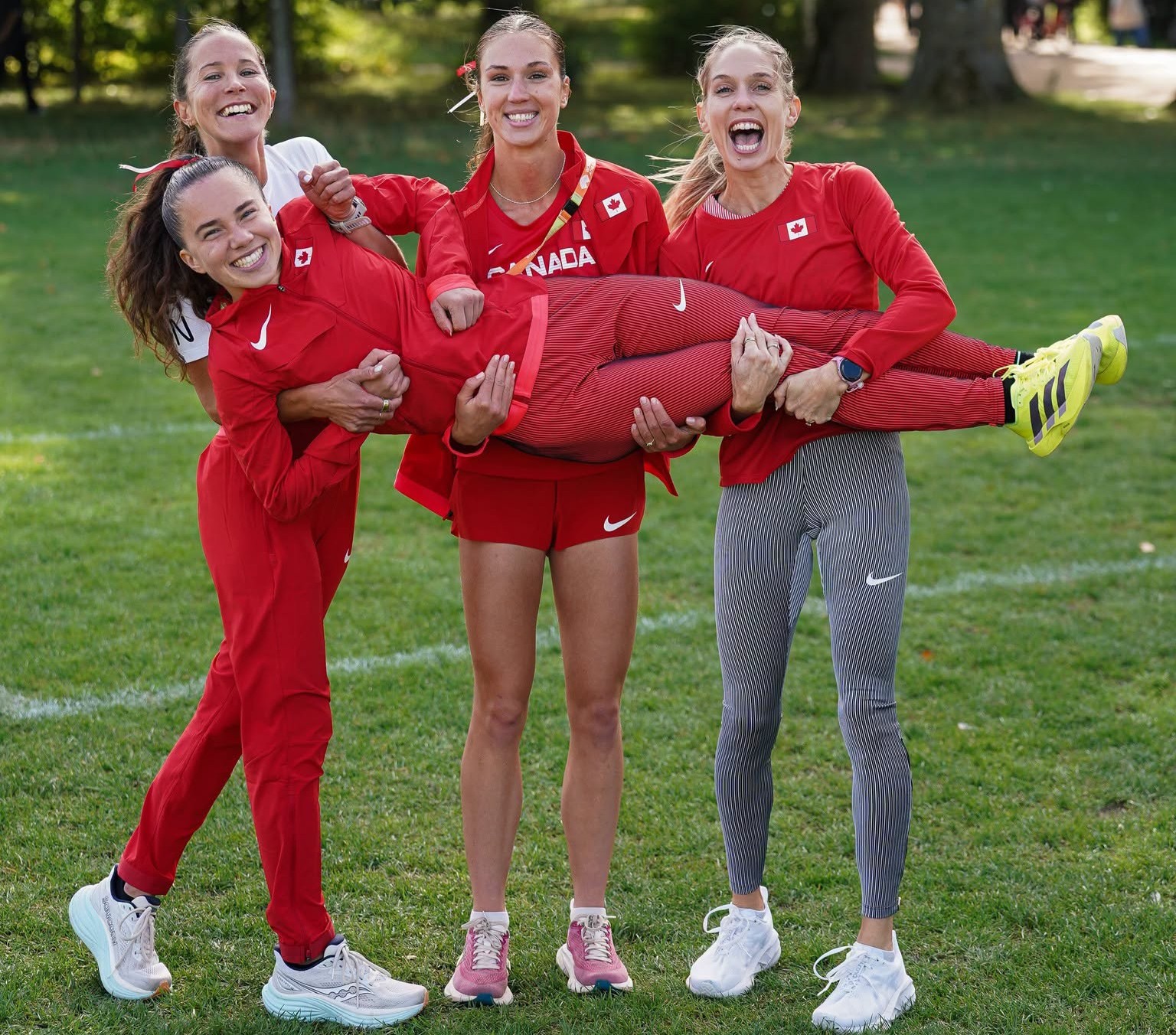
Keeler shaved 1:35 off Andrea Seccafien’s previous national record of 1:09:38, set in Marugame, Japan, in 2020. Seccafien broke Natasha Wodak’s record, achieved just two weeks prior in Houston, TX at 1:09:41. In a somewhat full-circle moment, Wodak was Keeler’s team captain for the Copenhagen race.
Barrie (pop: 167,000) is located approximately 90 to 95 kms north of Toronto and the shores of Lake Ontario.
Keeler went to the University of North Dakota and studied microbiology.
Personal bests
| Distance | Time | Location | Date |
| Half marathon | 1:08:03 | Copenhagen, DK | Sept. 2026 |
| 10,000m | 31:56.03 | Palo Alto, CA | April 2026 |
| 5000m | 15:14.76i | Boston, MA | Dec. 2025 |
| 3000m | 8:50.45i | Boston, MA | Feb. 2026 |
| 3000msc | 10:00.45i | Fargo, ND | May 2026 |
| i = indoors |
The interview
Christopher Kelsall: Congratulations on your national record run in Copenhagen. What were your expectations, both time- and position-wise, going into the World Road Running Championships half-marathon?
Jadyn Keeler: Thank you! Going into the race, my time goal was to break the Canadian national record of 1:09:38. As for position, I was hoping for a top 20 finish. I had a great 4-week block of training at altitude heading into it, and I knew I was in the best shape of my life. I’m proud to have been able to accomplish both of my goals in Copenhagen.
CK: Can you take me through the race? Tactically, how did you race it? Were you working with your Team Canada teammates for a while?
JK: In the first 5 kms, I was planning on finding a group of people who were running at a similar pace to me. That didn’t actually go to plan though, as the race went out very fast, and I found myself running almost alone after the first 2 km. I was able to eventually catch up to one runner whom I stayed with for most of the race. I went through the 10 km mark in 31:49, which was a new personal best for me. I knew I was on a fast pace and did my best to maintain it in the second half. The other runner and I worked together to reel in some runners from the chase pack ahead. I was able to finish strong with a new Canadian record of 1:08:03, which definitely surpassed my expectations.
CK: How helpful was your team captain, Natasha Wodak?
“Copenhagen was actually not on my radar until the end of June when I finished up my track season. I was just transitioning to working with my new professional coach and was trying to determine what races to target next. Natasha actually reached out to me and suggested I race the Canadian Half-Marathon Championships in August…”
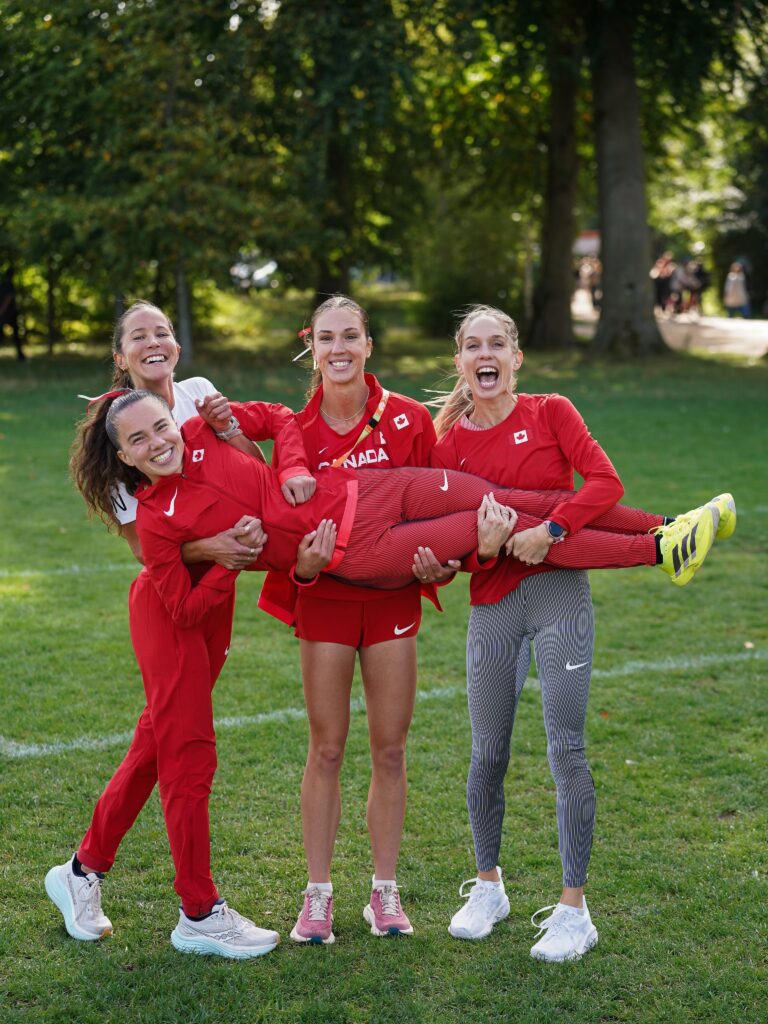
JK: Natasha was extremely helpful to have on our team, leading us as the Captain. She has many years of experience racing at world championships, the Olympics, and high-level events, so having her there was great to help me navigate my first world championship. Natasha gives great advice, is an incredible role model, and is a great person to be around. She is someone I’ve looked up to in the sport for a long time, so to get to toe the start line with her was an honour.
CK: You have run five new personal bests in 2026, but the half-marathon performance was a big jump in performance. Was Copenhagen a year-long goal and you peaked for it, or did all the races before just naturally lead to great fitness now?
JK: Copenhagen was actually not on my radar until the end of June when I finished up my track season. I was just transitioning to working with my new professional coach and was trying to determine what races to target next. Natasha actually reached out to me and suggested I race the Canadian Half-Marathon Championships in August, which was a way to qualify for the World Championships in Copenhagen. When I started my training block back in July, I definitely think I still carried some good fitness from the track season, and was able to build even more fitness leading into Copenhagen.
CK: Natasha has an eye for talent. Post-collegiate, how has your weekly volume of training changed? With 21 races since January, have you had a chance to contribute to your aerobic development through volume weeks?
JK: My weekly volume has increased a little bit, but not by much. I would say the main difference has been the consistency of my volume. In college, we were racing almost every other week, which commonly meant that every second week of volume would be slightly lower. Now as a pro, I’ve been able to keep my volume higher week after week, allowing me to get as much aerobic development as possible.
CK: What does a typical training week look like for you?
JK: I do workouts on Tuesdays and Fridays, which recently have consisted of a lot of threshold/aerobic workouts to prepare for the half-marathon. I do a long run on Sunday and fill in the rest of the days with easy running. I also make sure to incorporate some strides throughout the week as well.
CK: Do you enjoy the long runs, or are you all about the sessions and nailing splits?
JK: I love both long runs and sessions, but if I had to choose, I would say workout sessions are my favourite days of the week. One of the best parts about the sport is pushing the limits of what you think is possible, and I believe that workouts are the first step in doing that. I love stepping into that zone of discomfort during a tough workout, as those are the days that build my confidence to perform on race day.
CK: How much weekly volume have you gotten up to?
JK: The highest volume I’ve done during my half marathon build was 95 miles (153 kms), so I’ll be hoping to get to 100 miles (162 km) later this fall!
CK: Tongue-in-cheek, as a microbiologist, have you taken your own samples and sent them off for gene testing to find out if you have elite endurance genetics?
JK: I’ve never actually done any genetic testing before, but I’ve always wanted to! I think it would be cool to analyze my genes and see if there are markers that correlate to better endurance performance!
CK: Will you be seeking your PhD in microbiology, or have you had enough of school at this point?
JK: At the moment, I’m not in school as I adjust to life as a pro athlete. Although I would like to do a master’s or PhD later on in my career.
CK: You have raced well over a range of distances from the 1500m to the half-marathon. What do you prefer, mid-distance or long distance for racing and training?
JK: I absolutely prefer long distances for racing and training. That has been the case for me my whole life. I always say that as the race distance increases, I usually perform better as well.
CK: Growing up in Barrie, ON, did you run much at Kempenfelt Bay?
JK: I ran at Kempenfelt Bay all the time growing up. I used to have a lot of my practices with my running team there in high school, and I still commonly run there when I’m back home in Barrie. It’s one of my favourite locations for a long run!
CK: What other sports did you play before specializing in athletics?
JK: I was a competitive figure skater growing up, and I did that for 10 years before focusing on running. I also did hockey, soccer, gymnastics, dance, and cross-country skiing.
CK: Did winning the Canadian Half Marathon Championships five weeks ago in Edmonton give you confidence to compete with some of the best in Copenhagen?
JK: Yes, getting the win in Edmonton certainly gave me confidence that I could be competitive in Copenhagen. Although with only having one half-marathon under my belt and with it being my first world championship, I definitely still felt a bit unsure of what to expect.
CK: Not to pile on about the Edmonton situation, but you ran 1:12:12 on a course that was deemed 700m long. How many times did it go through your mind that you were probably good for sub 1:10, and that Andrea Seccafien’s national record was likely there for the taking?
JK: Right after the race in Edmonton, that was definitely something I thought about a lot. I felt like I had a real shot at the record that day, and I believed I was on pace for it during the race. While it was a disappointing situation, I knew that dwelling on it wouldn’t do much for me. I just moved on to the next target and set my sights on breaking it in Copenhagen. In fact, knowing that I likely would’ve run sub-70 had the course been correctly measured actually gave me more confidence that I could break the record in Copenhagen.
CK: What is next for you? Are you racing a cross-country season, or simply training for next spring?
JK: I don’t have any plans to race cross country as of right now. I’m mostly focusing on training for the spring, and I’m currently planning my big target races for 2027.
CK: Can you hint at what the season may include for distances or events?
JK: I’m excited to continue moving up in race distance. If all goes to plan, I’ll be making my marathon debut in the spring! Other than that, I definitely plan to continue racing some more half-marathons to try to get under the 68-minute barrier.
CK: Good luck and thanks for this.
JK: Thank you so much!