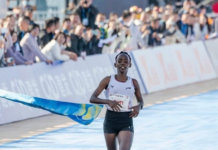

Kenya’s Agnes Ngetich ran the third fastest road 10km time in history on Saturday at the Urban Trail de Lille in Lille, France. She recorded a 28:58 performance.
The 25-year-old world cross-country champion ran through the halfway point in 14:15 before slowing ever so slightly. Ethiopia’s Chaltu Dida rolled in for second in a time of 30:02, and fellow Ethiopian Hirut Meshesha recorded a 30:05 third-place finish. It was not even close.
Ngetich has had a steady progression
Ngetich already has the world’s fastest time at 28:46 from the 2024 running of the Valencia 10km. The only other athlete to go under 29 minutes is Emmaculate Anyango Achol, a fellow Kenyan. She clocked 28:57 in that same race.
Currently, the only other athlete who appears capable of running “sub-29” on the road is the 10,000m world record holder Beatrice Chebet. Chebet is currently taking time off from racing as she is pregnant. She ran 28:54.14 at the 2024 Prefontaine Classic in Eugene, Oregon and is the only woman to run under 29 on the track.

What is likely next for Ngetich is to go after Chebet’s 10,000m track world record. Ngetich’s 10,000m best at this time is 30:27.23, which she ran at Nyayo National Stadium in Nairobi. Nairobi sits at 1,795 meters (5,889 feet) above sea level. If she ran that day at sea level, the performance would likely have been well under 30 minutes.
Who was that Emmaculate Anyango Achol, anyway?
Ngetich and Chebet are both known athletes for producing a steady stream of ever-improving performances. However, Emmaculate Anyango Achol was not well known before her Valencia run. Her performances leading up to the Valencia 10km did not indicate the incredible result on that day.
As it turns out, Anyango Achol is currently serving a six-year ban due to end in September 2030. This is related to the presence and use of testosterone and EPO. The increase in the ban from the standard four years to six years was due to “aggravating circumstances.” This can mean either multiple failed tests or more than one banned performance-enhancing substances she had tested positive for. All of her results starting from February 3, 2024, were disqualified.
The year before the 28:57 performance, she set personal bests of 15:22.80 and 32:51.58 in the 5000m and 10,000m, respectively. Her 10km road best was 30:01 in November 2023. So, in theory, she had begun doping by summer 2023 or autumn. As we found out, the rocket was launched with that road performance in November.
Clean athletes do not set off red flag performances so quickly at that level.
In May, the then 23-year-old was only running 32:51.58, the year prior, a minute slower. Now, after testing positive, her career is essentially over. Achol will only be 30 by the time her ban is up. But by then, six years will have passed, and any fast performances from then on will be met with great scrutiny.
Ken Rotich
Achol’s coach was Ken Rotich.
World Athletics wrote about Anyango Achol in March 2024, before the World Cross Country Championships in Belgrade, Serbia. “Anyango did not have support from her family when she decided to take up running, because nobody believed she had the talent. But now her family realize that she can make it, and that has made her want to achieve even more.” She finished fourth in that race.
Maybe her family was right on the first instinct.
Rotich is a coach based in Iten, Kenya, and he works with Elite Sports Marketing. He is known for guiding elite runners, including mentorship for Anyango Achol from her teen years. He is also linked to Clouds International Sports.
There does not appear to be a concise public date available indicating when Rotich and Anyango Achol began to work together. Still, all available evidence suggests that Rotich’s coaching of Anyango Achol started before or around 2019. Most likely around 2017–2018, when she relocated to Iten to pursue elite training as a 17 or 18-year-old. Thus debunking the theory that Kenya’s mass doping problem is caused exclusively by foreign coaches.