
© Copyright – 2025 – Athletics Illustrated
Usain Bolt’s world record of 9.58 seconds in the 100-metre sprint from August 2009 continues to stand a decade and a half later. The World Athletics points value for the performance is rated at 1356. Meanwhile, Ruth Chepngetich of Kenya ran the 2024 Chicago Marathon in 2:09:56 for 1339 points. Are they of similar value? Consider, the supershoe/superspike era and the distance of the events.
Supershoe records of note
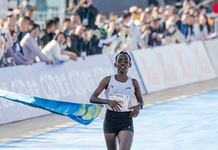
Ruth Chepngetich’s marathon world record from the 2024 Chicago Marathon at 1339 points is mind-boggling. The Kenyan is the first woman to break the 2:10 barrier. Running that time set the athletics community on its ear. The Kenyans were cheering, and the rest of the world said, “Enough is enough.”
On May 25, 2024, and then on Dec. 31, 2024, Kenyan Beatrice Chebet clocked two astounding times: 28:54.14 in the 10,000m event and 13:54 in a 5km road race. The two performances are rated at 1309 and 1295 points, respectively. Chebet is the first woman to run sub-29 and sub-14.
The ratings system is not perfect, however, across the distances and between the two genders, the rating at the top end of the scale, near world record levels is reliable enough. How we rate a 100m sprint against a 42.195km marathon is perplexing as the physiology in racing the events is not the same. But we will leave that to the experts.

Joshua Cheptegei of Uganda ran a 1302 performance in the 5000m to break Ethiopian great Kenenisa Bekele’s long-standing world record at 12:35.36. He also broke Bekele’s 10,000m record with a 12:35.36 or 1306-point ranked effort. These records are now coming up on five years old. Oddly, “early” in the supershoe era — perhaps not as advantageous as today?
Karston Warholm’s 400m hurdles world record sits at a staggering 1341 points with his 45.94-second performance from the 2021 Tokyo Olympic Games.
Pre-supershoe records
In August 2012, Kenyan David Rudisha ran a jaw-dropping 1:40.91 in the 800m event. The world record continues today with a points rating of 1:40.91. Rudisha’s performance was run before the major advancement in supershoes and superspikes. His performance is rated at 1301 points.
Moroccan, Hicham El Gerrouj ran 3:26.00 in the 1500m event on July 14, 1998, in Rome’s Golden Gala. This is another 1302-point performance.
Florence Griffith-Joyner continues to hold the world record in both the 100m and 200m sprints. Both performances have long been considered suspect. In 1988, she ran 10.49 and 21.34. Due to the speed, Griffith-Joyner’s masculine-like changes and her early death puts her Seoul Olympic race times on the suspect list. They are rated at 1308 and 1314 points, respectively.
Paula Radcliffe’s world record in the marathon at 2:15:25, which had many skeptics up in arms almost seems slow now.
Radcliffe’s time at the London Marathon in 2003 was considered aided due to having male pacers. World Athletics wanted to take the record away from her. She protested. Radcliffe would have finished nearly two kilometres behind Chepngetich (comparing the two finish times).
Brigid Kosgei ran 2:14:04, which the Kenyan accomplished during the 2019 Chicago Marathon, to break Radcliffe’s record. Tigst Assefa of Ethiopia then ran 2:11:53 in the 2023 Berlin Marathon to improve on Kosgei’s record, now 2:09:56 is the number. When will the parade of supershoe world records
It is unlikely that the points system can be calculated to correlate with the advancements in shoes. Who knows how that could be a thing with the evolving improvements? At the least World Athletics should place an asterisk beside world records and continue to publish pre-supershoe era world records as valid for the era.