

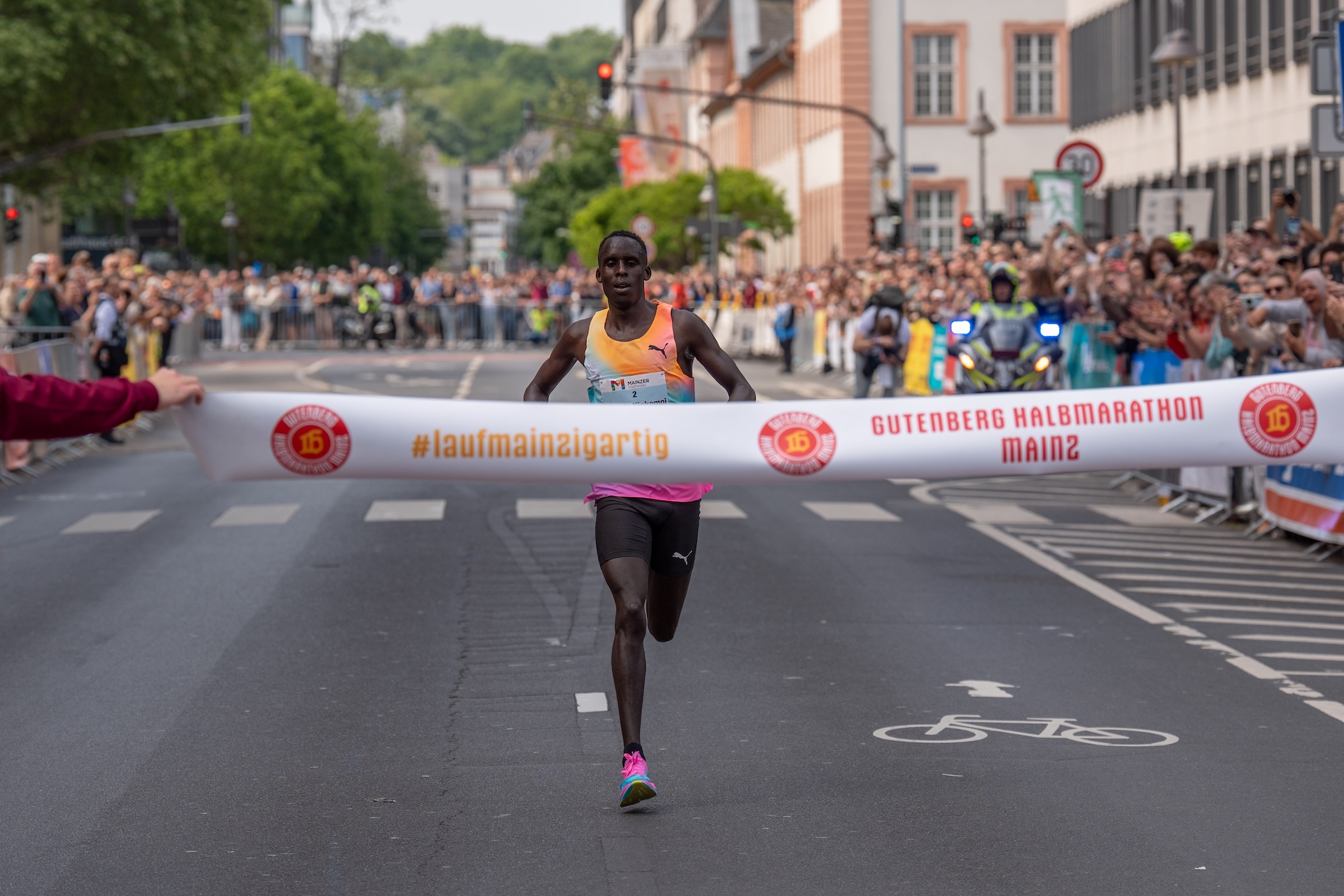
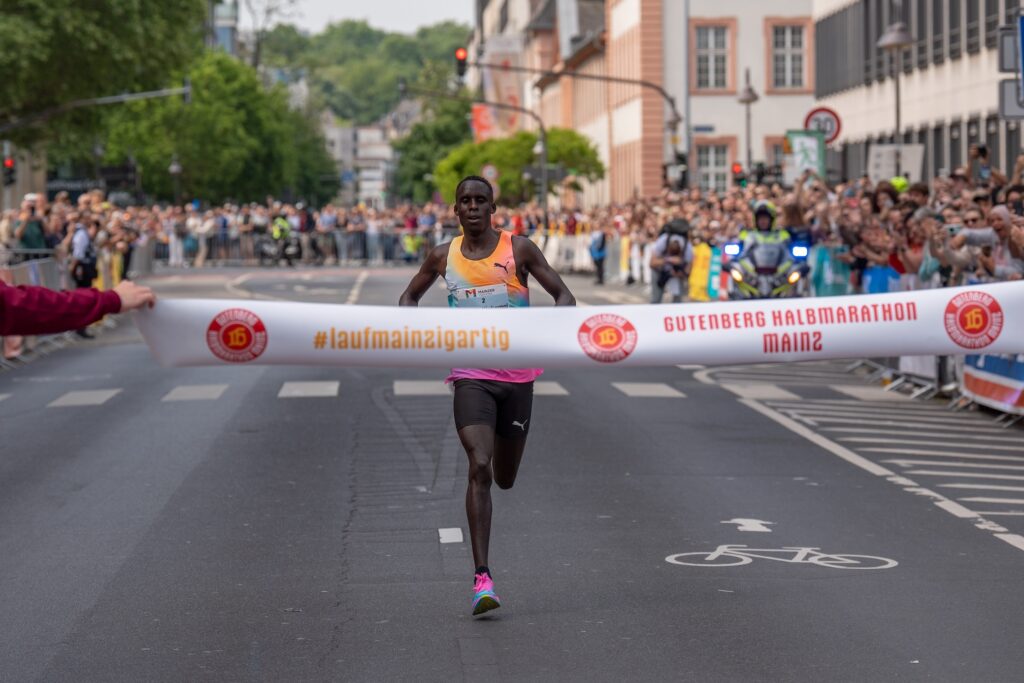
Dennis Kipkogei did not so much win the Gutenberg Mainz Half Marathon on Sunday as annex it. The 24-year-old Kenyan tore through the streets of Mainz in 59:14, reducing the course record to rubble and, in the process, nudging the race into a different category altogether. Germany has long had Berlin as its premier half marathon showcase. Mainz may now be demanding a seat at the same table.
Men’s race
Kipkogei arrived with little international baggage. Outside Kenya, he had raced only once before — at the Berlin Half Marathon in March — where he spent much of the morning masquerading as a pacemaker before hanging on for second in 59:11. That performance hinted at uncommon talent. Mainz confirmed it.
The race was effectively over by 10 kilometres. Kipkogei detached himself from the lead group with the casual cruelty elite East African runners can impose when the pace turns from ambitious to unsustainable. Behind him, fellow Kenyans Kelvin Kipruto and Jamal Kiprono were left to sort out the minor placings, clocking 60:25 and 60:29 respectively. Kipkogei was already somewhere else entirely.
The opening pace suggested something bordering on reckless — perhaps even a sub-59-minute performance — but warm conditions near 20C extracted their tax late in the race. Even so, Kipkogei missed his Berlin best by only three seconds.
“I came here to break the course record and I am happy that I managed it,” he said afterward. “I had a problem with my hamstring so my body did not feel that good. Otherwise I could have run even faster.”
That is the sort of quote that should make future competitors uneasy.
His 59:14 sliced more than 90 seconds from the previous course record of 60:50, and race director Jo Schindler understood the significance immediately.
“A winning time under one hour is of course something special,” Schindler said. “At the moment we are the eleventh-fastest half marathon in the world this year.”
Road racing is crowded with events promising world-class performances. Few deliver them. Mainz increasingly does. For the third consecutive year both course records fell.
Women’s race
In the women’s race, Kenya’s Beatrice Cheserek won in 68:02 after finally shaking Germany’s Blanka Dörfel over the closing kilometres. Dörfel, meanwhile, may have produced the performance that resonated most deeply with the home crowd.
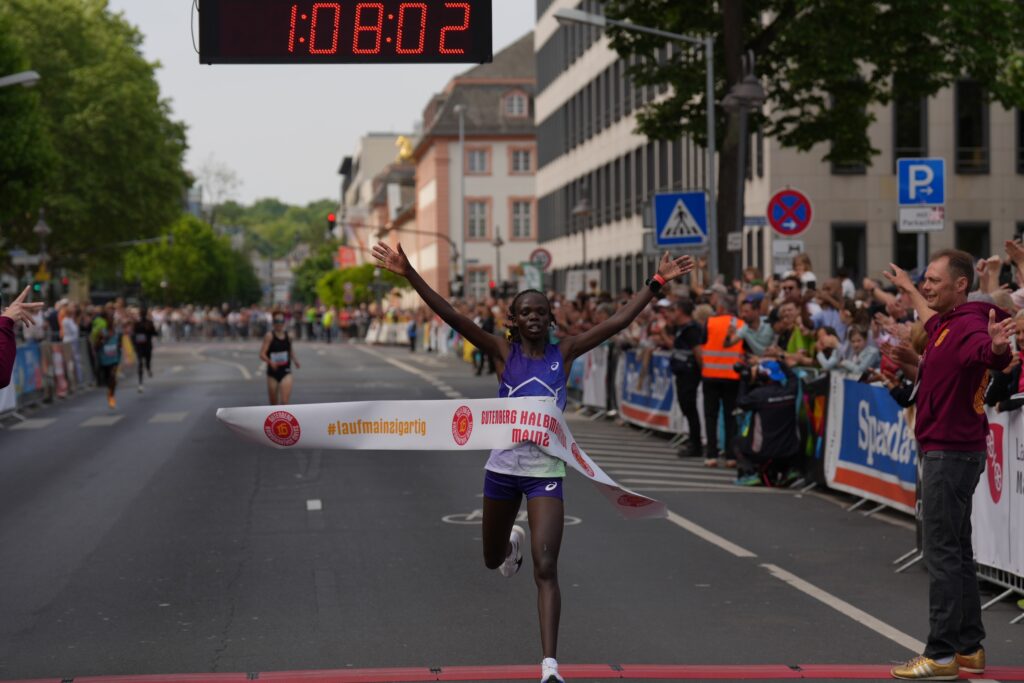
The 24-year-old German obliterated her personal best, improving from 69:46 to 68:06, moving to sixth on the all-time German list. More importantly, she ran with the sort of composure that suggests the result was not accidental.
“I just ran by feel,” Dörfel said. “I didn’t look at the splits at all. When I saw the clock in the finishing straight I was completely surprised.”
For long stretches, Dörfel appeared entirely unbothered by the credentials of Cheserek, whose lifetime best entering the race stood at 66:48. That confidence mattered. Distance running at the international level often hinges less on physiology than permission — the moment an athlete realizes they belong.
Ethiopia’s Emebet Kebede Dessie finished third in 69:01.
There were nearly 13,000 entries in the half marathon alone, and over 17,500 participants across the weekend’s events. But statistics rarely explain atmosphere. Mainz now feels like one of those races athletes circle in advance — fast, competitive, increasingly prestigious, and perhaps still just obscure enough to avoid the suffocating machinery surrounding the major marathons.
Tom Thurley was the top German man in 64:07, narrowly missing his personal best while continuing preparations for an autumn marathon campaign where he hopes to break 2:10.
For Kipkogei, the ambitions are already larger.
“If I am selected, I will compete at the World Half Marathon Championships in Copenhagen,” he said.
Based on Mainz, selection feels less like a possibility than a formality.
Results
More information is available online at: www.halbmarathon-mainz.de