
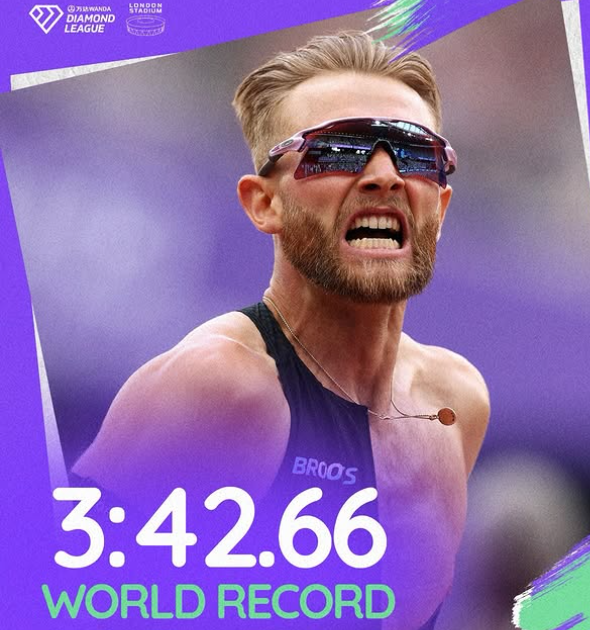
Great Britain’s Josh Kerr was not fooling around when he announced his intention to break Hicham El Guerrouj’s mile record. He was also not fooling around when he ran a time trial at elevation, splitting 1200m in 2:42.45. Putting his money where his mouth is, Kerr destroyed the 27‑year‑old 1609‑metre (mile) benchmark on home soil at the London Diamond League, clocking 3:42.66.
The crowd lost its mind. The timing was perfect: England is still reeling from its 3–1 semi‑final loss to Argentina at the FIFA World Cup, and the 60,000 inside London Stadium needed Kerr to come through. Their energy became one of the ingredients that propelled him through the business end of the race.
Kerr became the seventh British athlete to hold the mile record, and the first since the legendary Steve Cram in 1985.
On Friday, he ran 2:42.45 for 1200m at altitude (5,335 ft) in Albuquerque, New Mexico, paced by Brannon Kidder, who also paced him in London. Kerr’s splits in that effort were:
200m — 27.35
400m — 55.72
The 28‑year‑old entered the race as the sixth‑fastest man in history, owning a British record and personal best of 3:45.34.
Also in the field was American Yared Nuguse, fourth on the all‑time list.
Assisted by two pacemakers, who were scheduled to take him through 1,000m, Kerr was pushed on in pursuit of the record, helped further by wavelights along the curb set to world‑record pace.
He went through 1500m faster than his own British record and never wavered, emotion evident as he raised his arms across the line.
“It’s very overwhelming with the amount of hype. It’s silly to call it that early because there are a lot of things which can go wrong, but I am surrounded by amazing people and was able to stay consistent and put the work in,” Kerr told the BBC.
“If I am to leave my mark on this sport as a British legend, following in the footsteps of the legends behind me, I have to put in those performances.”
Other performances
In the much-anticipated 800m event, Keely Hodgkinson won in a time of 1:56.21. Dutch athlete Femke Broeders-Bol continues to run well in the 800m, clocking 1:56.46. Taking third was Ethiopian Tsige Duguma in 1:56.92.
Hodgkinson raced well, considering she was recently dealing with an injury. However, like Kerr, it was this season that she targeted to take the 43-year-old world record of 1:5
“It was quite important to win today; that was the main aim,” Hodgkinson told reporters.
“I’m a little disappointed in the time, but I’m OK with it, really… I’m not really chasing times.”
She was a full two seconds off of Audrey Werro’s 2026 world lead, 1:53.80. Werro and Hodgkinson continue to chase the current world record of 1:53.28, set by Jarmila Kratochvílová of Czechoslovakia on July 26, 1983.
In the men’s 800m is was a surprise result for Kenyan Emmanuel Wanyonyi, who managed just a fifth-place finish in the time of 1:43.31, nearly a second behind American Brandon Miller, who clocked in a 1:42.19 personal best performance. Mark English, an Irishman, also ran a personal best. Meanwhile, Engl of 1:42.97 and’s Max Burgin took third in 1:43.30.
Wanyonyi has also talked about taking the world record, which is 1:40.91 by fellow Kenyan David Rudisha. He has run 1:41.11, set way back in 2012.
In the men’s 400m, seven of eight athletes clocked under 45 seconds, including winner Benjamin Rai with his 44.05 in a new personal best. Matthew Hudson-Smith and Jacory Patterson took second and third, respectively. They finished in 44.18 and 44.25.
South Africa’s Wayde van Niekerk holds the fastest 400m in history. He ran the single lap in 43.03 seconds at the 2016 Rio Olympics. Thirty-two men have run sub-43. Rai’s time is the 36th-fastest in history.