

© Copyright – 2025 – Athletics Illustrated
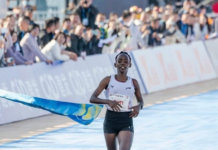
Des Linden announced her retirement as a professional long-distance runner. After 18 years, the 2025 B.A.A. Boston Marathon was the final performance in a long and prosperous athletics career.
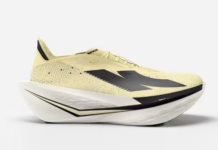
Opinion on super shoes
Being one to speak openly, Linden, when asked about the advent of super shoes in 2017, said, “That crushed me in a really big way. The shoes took away the core meaning of the sport, the competition. It was immediately clear how much they impacted the results.”
She also talked about first running when her father sent her out in sweats and “who knows what type of shoes.”
Shades of four-time Olympian Lorraine Moller of New Zealand, who recalls running barefoot as a child in the forest with her father.

Linden finished seventh in the 2016 Rio Olympic Games marathon. Her personal best is 2:25:55. She ran that time at the Houston Marathon in 2012 and ran the Boston Marathon in 2011, clocking 2:22:38. Linden won the race in 2018 during a Nor’easter—a storm that the southern California native relished when beating all others. For her Boston Marathon performances, she finished first, second, fourth two times, and eighth once.
Similarly, Moller won in Boston and won several times in Osaka. She was a versatile runner, setting the national U20 record in the 800m and was competitive in all distances up to the marathon. Moller went on to write the bestseller On the Wings of Mercury.
Linden is also an author and podcaster, also a whiskey connoisseur.
But the super shoes. For Linden, it took some of the joy out of the sport. For Moller, she was already retired when they arrived on the scene. She raced in glorified ballet slippers. Then, runners had to rely on the strength of their training only.
Different runners benefit in different ways when it comes to wearing super shoes, so they create an uneven playing field.
In an Athletics Illustrated interview with PhD Wouter Hoogkamer, part of the team that inspired the naming of the original Nike 4%, said that through their Nike-commissioned study, athletes improved 2-6%, so 4% is halfway between, hence the name. Asked who benefits 2% and who benefits 6%, he replied that they have “not done that study yet.”
But a fairly reasoned assumption is that a runner with a low-profile stride, like an ultramarathon runner, will benefit less. The athlete with the high knee lift and kick, landing with their bodyweight directly over the planted foot, will benefit more.
Femoral stress fractures
Linden’s major injury was a femoral stress fracture — a not-so-common injury for runners. Anecdotally, there appears to be an increase in femoral stress fractures in runners who train mostly or exclusively in super shoes.
In this 2023 National Library of Medicine opinion article, five athletes were documented with stress fractures. The correlating factor to training and racing exclusively in super shoes (shoes with carbon plates) is documented. (Bone Stress Injuries in Runners Using Carbon Fiber Plate Footwear).
More studies and, unfortunately, more athletes need to suffer this injury for the industry and the governing bodies of the sport to shift.
Linden has done much for the sport of athletics with her performances. She speaks openly in interviews, podcasts and statements (never one to shy away). It would be refreshing and helpful if more athletes would speak out about super shoes. The benefits, risks and how running is an expression of fitness, health, competitiveness and freedom.
And perhaps reliance on super shoes has created a market and a potential negative effect of an uneven playing field. And apparent injuries in some athletes. Not to mention a very high price tag, which will separate the haves from the have-nots.
Conclusion from the National Library of Medicine article
This Current Opinion discusses a possible association of BSIs with CFP footwear while recognizing the performance benefits that have been described. Advances in the evaluation and management of BSIs have been extensively published, and highlight the need to identify multiple risk factors for BSIs, including those that are modifiable. We recommend further research to better understand whether the association of BSIs with CFP footwear is unique to the described runners in this case series or applies to other running populations. Prior experience with metatarsal BSI with minimalist footwear led shoe companies to develop a more gradual program for transitioning to minimalist shoes; it is plausible that similar advances could be developed by shoe companies, researchers and clinicians to promote safety in sports when using CFP footwear. Further discussions are expected, and both sports industry and sports federations have a duty to respect the guidance and advice of medical professionals. The excitement surrounding this new technology, due to faster running times, is palpable for both athletes and the sports medicine community. We hope this article helps to guide better recognition of medical issues related to CFP footwear, the appropriate use of this new technology, and safety for our athletes.