
© Copyright – 2025 – Athletics Illustrated
While it is common for 5000 metre and 10,000 metre specialists to move up from their event toward the marathon, eventually, it is less common for a sprinter to move up to middle distances. Whether the 800m event is a long sprint or a short middle-distance race is an age-old debate; however, science tells us that it requires contributions of 60-70 per cent aerobic and 30 to 40 per cent anaerobic strata.
This is a newer look at the physiological contributions. For decades, the split was considered roughly 51/49 — either way, it is an aerobic-oriented race.
So, this means that 800m runners should do distance training to set an aerobic base. While some international athletes run a base phase of approximately 100 to 120 (60-75 miles) kilometres per week, some train more and some less. For example, the current fastest 800m runner, Keely Hodgkinson of the UK, runs approximately 50km per week in her training, or approximately 30 miles.
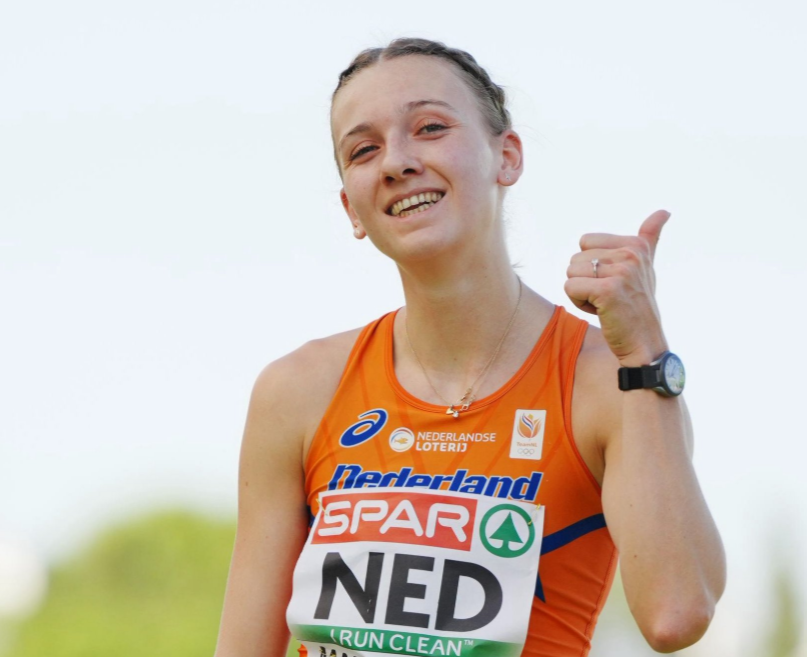
The Netherlands’ Femke Bol, a 400 metre and 400 metre hurdles specialist, is doubling down and moving up to the 800 metre event. Does she naturally have the aerobic talent like it is presumed Hodgkinson does, or will she need to train 100 to 160 kilometres per week this fall and winter?
Femke Bol
Bol, who holds two world records, two “world’s best known times,” two European records and eight national records at age 25, apparently has enough time left in her career to move up the two-lap event.
She has earned three world championship gold medals and three silver medals, as well as one bronze. Bol has two bronze, one silver and one gold Olympic medal from the 2021 Tokyo and 2024 Paris Games.
Bol’s 800 metre best is from 2017, when she was just 17 years of age and sits at 2:19.51. Whether she becomes world-class in the 800m or not, she will surely improve on that time.
While her 400m best of 49.17 cracks the top-100 fastest times in history, the results above her are shared by fewer athletes. For example, American Sydney McLaughlin-Levrone (SML) has run faster six times. Marita Koch of the former East Germany, 14 and the Czech Republic’s (Czechoslovakia) Jarmila Kratochvílová, 10. The world record is 47.60. Only SML has a chance to better it, as she has already run 47.78, the second-fastest time in history. While Bol’s 49.17 is fast, there is a gap too large for Bol to close.
Bol is closer to the top in the 400m hurdles with her European record of 50.95, which she ran in July 2024. The world record is 50.37 and is held by SML. SML holds the three fastest times in history, 50.65 and 50.68. Bol holds the fourth and fifth-fastest times ever at 50.95 and 51.30.
Between the two athletes, they hold 38 of the 50 fastest times in history, with SML having run 13 of them and Bol holding 25, as she has raced much more often.
The 800 metre event
The world record in the 800m event is 1:53.28 by Kratochvílová, which she ran in Munich, Germany (München) in 1983. The fastest performance in modern history is from Keely Hodgkinson at 1:54.61 from July 2024. Before that, Pamela Jelimo in 2008 ran 1:54.01. South Africa’s Caster Semenya has run faster times and has two of the top-10 with a 1:54.25; however, there is debate about her belonging in the women’s sprint as she lives with a condition called DSD or differences in sexual development, which causes her to naturally produce nearly as much testosterone as men do. Two times in her career, World Athletics had moved to require her to take testosterone-limiting medication, she did so for one era, and it slowed her markedly.
Hodgkinson has her sights on the world record. She currently holds the British record at 1:54.61.
In 1980, Nadezhda Olizarenko of Ukraine ran 1:53.43, for the then world record; now, it stands as the second-fastest all-time. Kratochvílová’s 1:53.28 is now tops. Both are suspected of being tainted by the Eastern Bloc drug era when the Soviet Union, Czechoslovakia and East Germany existed under the regimes of strict communism and systematic doping.
Before the advent of super shoes, breaking two minutes was a benchmark that put athletes at the global championships level: the Olympics and World Championships. The needle has moved on the standard, and now 1:58 is the new sub-2, as sub-1:59 has been run nearly 3000 times in history.
“I’m ready for the next challenge, a new stimulus, a completely different kind of race,” Bol said in an Instagram post Friday. “It’s different from what I’m used to in the 400m hurdles, and I’m really excited to explore that.”