
© Copyright – 2026 – Athletics Illustrated
Uganda’s Jacob Kiplimo and Kenya’s Beatrice Chebet have something in common. In their respective events, they are the fastest in the world—he in the half-marathon, and she over the 5,000- and 10,000-metre distances.
They share one more thing.
The two are represented by the same agency, Rosa & Associati owned by Frederico Rosa.
An overarching question on the minds of many athletics fans is, “How do they make winning look so easy?”
Rosa & Associati
Speculation around Rosa and Rosa & Associati starts and ends with a well-publicized history of the agency’s athletes testing positive for banned performance-enhancing drugs. There is also a history of athletes having Athlete Biological Passport anomalies, tampering with the doping-control process, and missing three tests in 12 months—known as a Whereabouts Failure.
As far as the public knows, neither Kiplimo nor Chebet has ever tested positive for performance-enhancing drugs or substances (PEDs). Likewise, Rosa has not been convicted of anything untoward. However, he has been formally investigated and charged in a Kenyan court. The charges were later dropped.

In 2016, Rosa was accused of providing PEDs to Kenyan athletes. The case followed the suspension of his former client, Rita Jeptoo, for use of the red blood cell booster Erythropoietin (EPO). He categorically denied the charges. At the same time, an associated coach, Claudio Berardelli, was also being questioned.
Rosa was charged with conspiracy to cause doping, with accusations that he facilitated the use of prohibited substances for athletes under his management. The investigation was part of a larger crackdown on doping in Kenyan athletics. Jeptoo, a prominent marathon runner managed by Rosa, was banned for two years in 2014 after testing positive for EPO.
The 2016 scandal significantly damaged the reputation of his firm, leading to intense scrutiny of its athletes and coaching staff.
The year prior, both Rosa & Associati and Volare Sports, another agency representing East African athletes, were suspended in Kenya for six months.
Berardelli was fired. At the time, Rosa partially threw him under the bus, saying, “We do not say that Claudio is involved in the problem, and we know he has nothing to do with it, but he was not able to pay enough attention to his own athletes,” Rosa said.
Jeptoo is not the only Rosa & Associati athlete banned for doping. The three-time Boston and two-time Chicago Marathon winner was stripped of her Marathon Majors title and wins going back to 2014.
Around the same time, Volare Sports agency’s Wilson Kipsang, who has won several major marathons, including New York, was caught doping. It was the beginning of what put Kenya on the World Anti-Doping Agency’s watch list and exposed the unchecked doping problem in the country. The belief that Kenya was populated by people who were simply born to run, began to wane.
Kenya’s doping problem is significant
Since 2012, somewhere between 400 and 500 Kenyan athletes have been suspended, banned, or investigated for doping-related offences.
While Kiplimo is not Kenyan, but Ugandan, the same overarching motivations to dope prevail. The lure of money that the athletes would never otherwise be able to earn in their lifetime is there for the taking. Tens of and hundreds of thousands of US dollars, or Euros equivalent to a lottery win for East Africans, make the risk well worth the venture.
Now, athletics fans are concerned over other world-leading athletes like fellow Ugandan Joshua Cheptegei, who currently holds the world records for the 5000m and 10,000m events. He has run 12:35.36 and 26:11.00.
Was Kenyan David Rudisha’s 800m world record run of 1:40.91 aided? The performance happened in 2012, before super shoes and bicarb became commonplace. The World Athletics points performance rating for that run is 1301. Mostly just the world records are over the 1300 benchmark in both genders.
Men
Javelin: Jan Železný (98.48m – 1996) – 1365 points
100m: Usain Bolt (9.58s – 2009) – 1356 points
200m: Usain Bolt (19.19s – 2009) – 1352 points
Long Jump: Mike Powell (8.95m – 1991) – 1346 points
400m Hurdles: Karsten Warholm (45.94s – 2021) – 1341 points
Pole Vault: Armand Duplantis (6.26m – 2024) – 1339 points
Shot Put: Ryan Crouser (23.56m – 2023) – 1334 points
3000m: Jakob Ingebrigtsen (7:17.55 – 2024) – 1320 points
5000m: Joshua Cheptegei (12:35.36 – 2020) – 1302-1306 points
800m: David Rudisha (1:40.91 – 2012) – 1301 points
1500m: Hicham El Guerrouj (3:26.00 – 1998) – 1302 points
Marathon: Kelvin Kiptum (2:00:35 – 2023) – 1307 points
Women
Discus Throw: 76.80m – Gabriele Reinsch (GDR), 1988 (1380+ pts)
Shot Put: 22.63m – Natalya Lisovskaya (URS), 1987 (1370+ pts)
Long Jump: 7.52m – Galina Chistyakova (URS), 1988 (1330+ pts)
Heptathlon: 7291 pts – Jackie Joyner-Kersee (USA), 1988 (1330+ pts)
400m Hurdles: 50.37s – Sydney McLaughlin-Levrone (USA), 2024 (1320+ pts)
High Jump: 2.10m – Yaroslava Mahuchikh (UKR), 2024 (1310+ pts)
100m: 10.49s – Florence Griffith-Joyner (USA), 1988 (1310+ pts)
10,000m: 28:54.14 – Beatrice Chebet (KEN), 2024 (1308 pts)
200m: 21.34s – Florence Griffith-Joyner (USA), 1988 (1300+ pts)
Javelin Throw: 72.28m – Barbora Špotáková (CZE), 2008 (1300+ pts)
400m: 47.60s – Marita Koch (GDR), 1985 (1300+ pts)
Hammer Throw: 82.98m – Anita Włodarczyk (POL), 2016 (1300+ pts)
It’s not just the speed, but how easy it appears.
Kiplimo ran the half-marathon in Barcelona last year in a time of 56:42. World Athletics disqualified the performance due to his receiving assistance from the lead car, which broke the wind for him.
He came back two weeks ago and ran 57:20 to break Ethiopian Yomif Kejelcha’s certified world record by 10 seconds in Lisbon. Kiplimo finished the race as if he were out for a fun jog in the park.

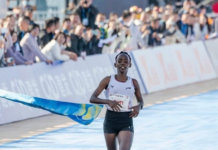
Likewise, Chebet has won her races with ease and decorum, meanwhile destroying past benchmarks previously not thought possible. She is the first female to break the 29-minute barrier in the 10,000m and 14 minutes in the 5000m and 5 km on the road. Her times are head scratchers: 28:54.14, 13:58.06, and 13:54. She won Olympic gold in Paris in both events and accomplished the same feat during the Tokyo World Athletics Championships. She is a three-time winner of the World Cross Country Championships.
Chebet holds five of the top-12 5000m times in history.
Kiplimo’s 56:42 seems beyond human capability, certainly in terms of his disposition upon finishing, always relaxed as if he were out for a jog.
Kiplimo holds three of the four fastest times in history. And five of the top-11.
Another Rosa & Associati athlete, Ruth Chepngetich, holds the marathon world record, having run 2:09:56. This result destroyed the 2:11:53 run by Ethiopian Tigist Assefa, whose performance was already considered “off the charts.”
Historically speaking, it was not that long ago that Great Britain’s Paula Radcliffe set the world record of 2:15:25. At the time, it was considered so fast that World Athletics attempted to disqualify it based on the notion that it was falsely aided by a group of men (like Kiplimo’s car issue).
The performance continues to be fast now, but no longer outrageous, having been bettered nine times first by Kenyan Brigid Kosgei (2:14:04), and then by Assefa and Chepngetich, among others.
While athletes are now aided by ever-improving super shoes and the lactate-sparing sodium bicarbonate (bicarb), there is no evidence yet that bicarb, together with PEDs, has some sort of exponential effect. However, it was not that long ago when bicarb was considered only helpful over middle-distance events. Now, the science is suggesting it may help over efforts as long as the marathon.
According to the National Institute of Health, “based on current research, there is no direct evidence that bicarb has an exponential, synergistic, or compounding effect on the physiological performance-enhancing outcomes of EPO. While both are used to improve endurance, they function through different, non-overlapping mechanisms.”
How is it that these historic times are recorded with such ease? Cocktails?
Chepngetich was suspended for testing positive for a masking agent and diuretic at allegedly 140 times the allowable amount. What was she hiding elephant stimulants?
The incentive
While there is validity in the fact that East Africans benefit by living at elevation and walk and run many places for transportation, therefore are potentially more suited to endurance events, there is no getting around the ease with which these athletes win at the world-class level. The same applies to Ethiopians and Ugandans.
The financial incentives are life-changing. And if the athletes are not winning major prize money and signing lucrative endorsement contracts, they may be getting full-ride scholarships in the NCAA or gaining Permanent Resident Status leading to citizenship to live a better life elsewhere.
But each time an athlete cheats and wins or lands on the podium, they displace other athletes who may be competing without drugs. This is theft and can result in taking someone else’s prize money, endorsement contracts, bonuses from events or sponsors, travel, appearance fees and recognition. And this does not just apply to the next runner, but has a domino effect down the line of finishers.
For example, Canadian Hilary Stellingwerff finished out of the finals of the 2012 London Olympic Games 1500m. As it turns out, she was beaten by a drug cheat. Later, half of the field was disqualified for doping. She may have missed out on hundreds of thousands of dollars, invitations to events and recognition, perhaps an endorsement contract.
A full-ride scholarship at an Ivy League school may be worth $75,000 to $80,000 annually.
Winning the New York City Marathon nets the first male and first female $100,000 each. Prizing goes to 10th place. The course record bonus is $50,000.
How do destination marathon runners feel about spending thousands of dollars to travel to a big city race to find out their hard-earned money is potentially funding a doper? How do sponsors feel that their investment may be fuelling the legs and heart of a cheat?
For the London Marathon, first prize is a little less lucrative, but still significant at $55,000, going 12 deep.
Performance Bonuses in London
World Record: An additional $125,000 is awarded for setting a new men’s or women’s world record.
Course Record: An extra $25,000 bonus is available for breaking the men’s or women’s course record.
Time Bonuses: Substantial bonuses are also offered for achieving specific fast times (e.g., sub 2:02:00 for men or sub 2:16:16 for women).
Many other marathons, like Grandma’s Marathon in Duluth, MN, offer $10,000 for the win. While significantly fewer dollars, there are many opportunities in North America and Europe at this value. A runner from a so-called third-world country can do well, winning a few medium-level marathons.
An Olympic gold medal pays $37,500 in the US, $20,000 for Canadians and Australians. Japanese athletes earn $33,000 USD for taking gold. Kenya pays $23,000 USD-a significant value in Kenya.
The sport has been here before. Stunning performances, effortless dominance, and times that appear to bend the limits of physiology. We celebrate them—until we don’t.
Kiplimo and Chebet may very well be clean. Perhaps they are simply the next evolutionary step in distance running. But athletics has long forfeited the luxury of blind belief. Too many records have been rewritten years later, too many medals reassigned in quiet ceremonies long after the stadium lights went dark.
So the performances stand—for now. The clock has recorded them, the record books accept them, and fans are left to decide how much faith they are willing to invest. In modern athletics, brilliance is no longer enough. It must also withstand the slow, patient test of time.
Because in this sport, history has a habit of revisiting the finish line.
Other Rosa & Associati athletes caught doping
Agatha Jeruto is an 800 metre runner who tested positive for norandrosterone in 2015 and received a four-year ban.
Jemima Sumgong, the 2016 Olympic champion, tested positive for EPO in 2017, but still retained her gold medal. Her suspension was later extended to eight years for tampering with the anti-doping process.
Visiline Jepkesho, Sumgong’s teammate, was suspended too. As was Asbel Kiprop who was the 2008 Olympic 1500m champion. He tested positive for EPO and served a four-year ban from 2018–2022. He also found himself in other trouble related to domestic issues.
Lawrence Cherono is the 2019 Boston Marathon and Chicago Marathon champion who received a seven-year ban in 2024 for testing positive for trimetazidine and then tampering.
Purity Rionoripo the 2017 Paris Marathon champion tested positive for the diuretic furosemide and received a five-year ban from 2022 to 2027.
Mathew Kisorio won the national half-marathon championships in 2012. He was caught with steroids and later was suspended for whereabouts failure.
Sarah Chepchirchir was the 2017 Tokyo Marathon champion who was banned four years for violations found in her Athlete Biological Passport (ABP) and then tested positive for testosterone upon her return in 2024.
Titus Ekiru ran a 2:02:57 marathon. He received a 10-year ban for triamcinolone acetonide, pethidine, and then tampered with the process.
Sheila Chelangat finished 16th in the Paris Olympic Games 10,000m final and holds a 66:06 half-marathon time. She is provisionally suspended for EPO usage.
Faith Chepkoech clocked a 30:22.77 10,000m PB. She was banned for three years for EPO.
Nijel Amos won silver at the 2012 London Olympic Games in the 800m. He tested positive for metabolites of GW1516 and was banned for three years.
Thiago Braz, the 2016 pole vault Olympic champion, was provisionally suspended in July 2023 following a positive test for Ostarine glucuronide and handed a 16-month ban that ran through November 2024.
Marius Kipserem won the 2016 and 2019 Rotterdam Marathon and was banned three years from Sept. 2022 after admitting to a positive for EPO.
Ruth Chepngetich current marathon world record holder with a 2:09:56 from her win at the 2024 Chicago Marathon. She also won in 2021 and 2022 and is the 2019 World champion. She tested positive for an alleged 140 times the legal amount for a diuretic masking agent.
Maryna Bekh-Romanchuk, a world championships silver medallist in the long jump and triple jump was banned four years after testing positive for metabolites of testosterone.
Cornelius Kibet Kiplagat a 2:04:54 marathon PB from his runner-up finish at the Barcelona Marathon back in March 2025 and was just banned 5 years for testing positive for EPO and CERA.
Kiplimo’s 57:20 splits
Jacob Kiplimo just ran 57:20 for the half marathon.
He ran 4:22 per mile / 2:43 per km.
He ran four consecutive 13-minute 5 kms.
Splits:
5K – 13:28
10K – 27:00 – 13:32
15K – 40:52 – 13:50
20K – 54:23 – 13:31
Half – 57:20 –
- – 2:43/per km
– 4:22/per mile